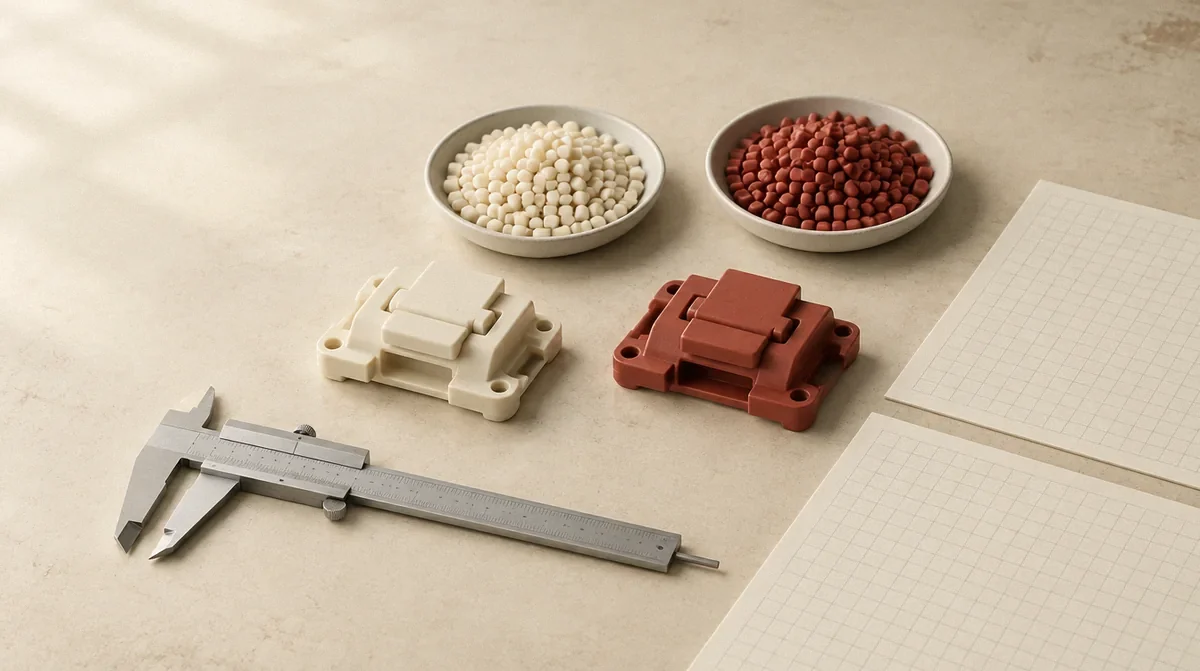
Turn “equivalent” into a reviewable change request
A supplier says the approved resin is unavailable and offers an equivalent plastic. The useful first response is a request for evidence, with a clear boundary: proposing a replacement does not authorize production. Ask which exact grade would change, why the supplier recommends it, and which part requirements the recommendation addresses. Give the proposal its own identifier so drawings, samples and emails refer to the same change.
This guide provides a working record for that review. It is intended for an inventor coordinating a material change with a molder and an engineer. It does not select a resin for a particular safety-critical application or certify a finished product. The final decision needs the people responsible for the design, manufacturing process and any applicable customer or certification requirements.
Start with the currently approved bill of materials, the list that identifies what the product is made from. Copy the exact material designation and drawing revision. If the drawing only says “nylon” or “ABS,” first resolve what was actually ordered and tested. Otherwise there is no reliable baseline against which to compare the proposed substitute.
Identify both grades before comparing numbers
Create two columns headed approved material and proposed material. In each, record manufacturer, full trade name, grade suffix, color code, filler or reinforcement description, and the supplied form. Attach dated technical data sheets and the processing information. Ask the supplier to mark missing fields instead of completing them from a similar product listing.
As a practical example of the detail a molder may require, Protolabs’ customer-supplied resin instructions request the trade name, grade including colorant code, safety documentation and technical data sheet. Its virgin-resin restriction is specific to that service, not a universal rule for all molders. Ask your own supplier what it will accept and how it will identify the material used.
Separate a distributor change from a grade change. Two distributors may supply the same manufacturer’s exact designation, but check traceability. Conversely, a familiar distributor can offer a different compound under a similar description. For a renamed grade, request the manufacturer’s written mapping and its stated limitations. Keep that confirmation with the change record rather than silently changing the part description.
Build a comparison that exposes missing evidence
Use the following worksheet as an editorial working template. Add rows for your product’s actual failure modes; do not treat the rows as a complete engineering specification. Give every requirement an owner who can explain why it matters and what evidence would resolve a gap.
| Review row | Record for each grade | Reason to keep the decision open |
|---|---|---|
| Material identity | Manufacturer, designation, color and formulation information supplied | Only a polymer-family name or sales description is available |
| Mechanical comparison | Property, value, units, method, temperature and sample condition | The numbers describe different properties or conditions |
| Production fit | Molder’s review of the actual tool, process and critical dimensions | The recommendation is based only on test specimens |
| Use conditions | Required load, duration and relevant exposure; supporting test reference | A needed condition has no evidence |
| Applicable approvals | Exact record and scope, plus reviewer responsible for the finished product | A material rating is offered as approval of the complete assembly |
| Supply and traceability | Available quantity, lot identifiers, delivery commitment and document linkage | A promising sample cannot be connected to a repeatable production supply |
| Decision | Hold, trial only, reject, or approved for a defined scope | No named approver, revision or effective lot |
A blank field means unknown. It should not become zero, “not applicable,” or an assumed match. Where a property is irrelevant, write why it is irrelevant to this part. That distinction prevents a reviewer from mistaking an unfinished comparison for a deliberate engineering decision.
UL Prospector’s guidance on alternative plastics recommends prioritizing requirements and warns that tooling and shrinkage can complicate substitution. It also suggests asking manufacturers for information omitted from a data sheet. Use that approach to build a shortlist; a search result is not permission to release a production lot.
Check the conditions attached to every value
Before ranking two values, put their test-method references and conditions beside them. A unit conversion changes the expression of a measurement, not the procedure that produced it. If the methods differ, mark the comparison unresolved and ask a qualified reviewer whether the data can support your particular screening decision. Do not invent a universal conversion factor between test methods.
For polyamides, moisture condition is a concrete example. The BASF Ultramid brochure, mechanical-properties section, explains why its data distinguish dry and conditioned samples: moisture uptake changes key mechanical properties. Therefore, record the condition rather than comparing a dry value in one column with a conditioned value in the other. This example concerns the polyamides discussed by BASF; it is not a claim that every polymer responds identically.
Use separate entries for properties that answer separate questions. Stiffness, breaking behavior and dimensional fit are not interchangeable acceptance criteria. If your previous decision was based on a particular test, preserve its full report and ask whether that method still addresses the intended use after the change. A favorable new number does not explain an untested condition.
For a warm, continuously loaded part, consult the existing guide on heat deflection temperature and service conditions. For a replacement that is being demonstrated with printed samples, review which conclusions transfer from printing to molding. Those are separate questions; keep this change record focused on the two proposed production grades.
Worked example: a latch housing with three open questions
Consider a hypothetical unpowered storage-box latch housing. The approved material is fictional Grade A; the supplier proposes fictional Grade B. These names and observations are illustrative, not measurements of commercial resins. The design owner has already defined fit, opening force and repeated-use requirements in a product-specific test plan.
| Evidence received | What the reviewer records | Next decision |
|---|---|---|
| Both sheets identify a polyamide, but the modulus values use different moisture conditions | Not yet comparable | Request matched-condition information |
| The molder expects Grade B to run in the existing tool, but has made no parts | Process proposal only | Agree a limited trial and its measurements |
| A printed housing opens smoothly | Useful handling observation; no molded-lot evidence | Test the actual molded trial housings |
The decision is “hold production release; prepare a trial proposal.” This is useful progress, even though it is not a material approval. The supplier now knows the missing evidence and does not have to guess whether a reassuring email permits a full order.
Suppose matched-condition data later support further evaluation and the molder produces a labeled trial batch. The reviewer compares the actual housings with the existing criteria. One cavity produces an out-of-limit fit. Record the cavity, measured dimension and process information; do not average that failure away because the other samples passed. The team can then investigate the specific issue before deciding whether another trial is worthwhile.
Even if a subsequent trial passes, its conclusion should name the tested configuration. “Grade B is equivalent” hides the scope. “Grade B, specified color, drawing revision C, reviewed process and listed acceptance evidence” gives the next purchase order something concrete to reference.
Agree the trial before ordering samples
Write the trial question first: what observation would permit the next decision, and what result would stop it? Ask the design owner and molder to agree the trial quantity, relevant cavities or production conditions, sample conditioning, measurement method and acceptance criteria. There is no universal sample count in this guide. A handful of good parts cannot justify an unsupported reliability claim.
Label trial parts so their material lot, drawing revision and manufacturing record remain connected. Keep original-material reference samples where they provide a useful comparison. Record when measurements happen and how parts were stored. If a result changes after conditioning or assembly, the record should make that sequence visible.
Ask the molder to identify any process changes needed for the candidate. Do not require identical settings merely to make the test look controlled; inappropriate settings would answer the wrong question. Instead, separate a material comparison from a comparison of two complete material-and-process combinations. State which question the trial is designed to answer.
For each failed criterion, record the result, the proposed explanation and the next discriminating check in different fields. “Probably the resin” is a hypothesis, not a finding. This small distinction prevents an expensive loop of changing materials without learning whether the part, process or measurement caused the problem.
Keep material ratings separate from product approval
When a product relies on a recognized material, obtain the actual record for the proposed designation. The UL Yellow Card guide shows material information alongside conditions such as color and minimum thickness. Check the applicable entries and notes. A rating copied into a supplier email does not establish that the proposed configuration is covered.
Have the person responsible for the product’s approval determine whether the substitution affects its existing evaluation. Record that answer before release. Do not infer a universal retest rule from a discussion forum, and do not describe the whole product as certified merely because one candidate material has a Yellow Card. This worksheet organizes the question; it does not replace the applicable evaluation.
A supplier request you can adapt
Use this as a technical coordination note, then adapt it to the accepted purchase terms. It is not a legal contract.
Please identify the proposed replacement by manufacturer, full grade and color code. Attach current technical and processing documents and compare it with the approved designation on drawing [revision]. List differences and missing data, especially for [our critical requirements].
Please propose a separately identified trial with material-lot records, sample quantity, test conditions, acceptance criteria, timing and cost. Identify process or tooling changes you expect. State which approvals or customer reviews remain open.
This request asks for a proposal. Please obtain written release for the specified change before using the substitute in our production order. Our decision record will identify the permitted scope and effective lot.
Close the record with a named decision owner, date, evidence references and disposition. If approved, carry the exact designation into the controlled drawing or material list and the purchase order. Define how remaining old-grade inventory will be identified. If rejected, preserve the reason so the same unsupported proposal does not return under a slightly different description.
The practical outcome is a traceable decision about a particular change. You can accept a well-supported alternative, authorize only a trial, or keep the existing grade while gaps are resolved. Each outcome is more useful than treating the supplier’s word “equivalent” as the entire specification.