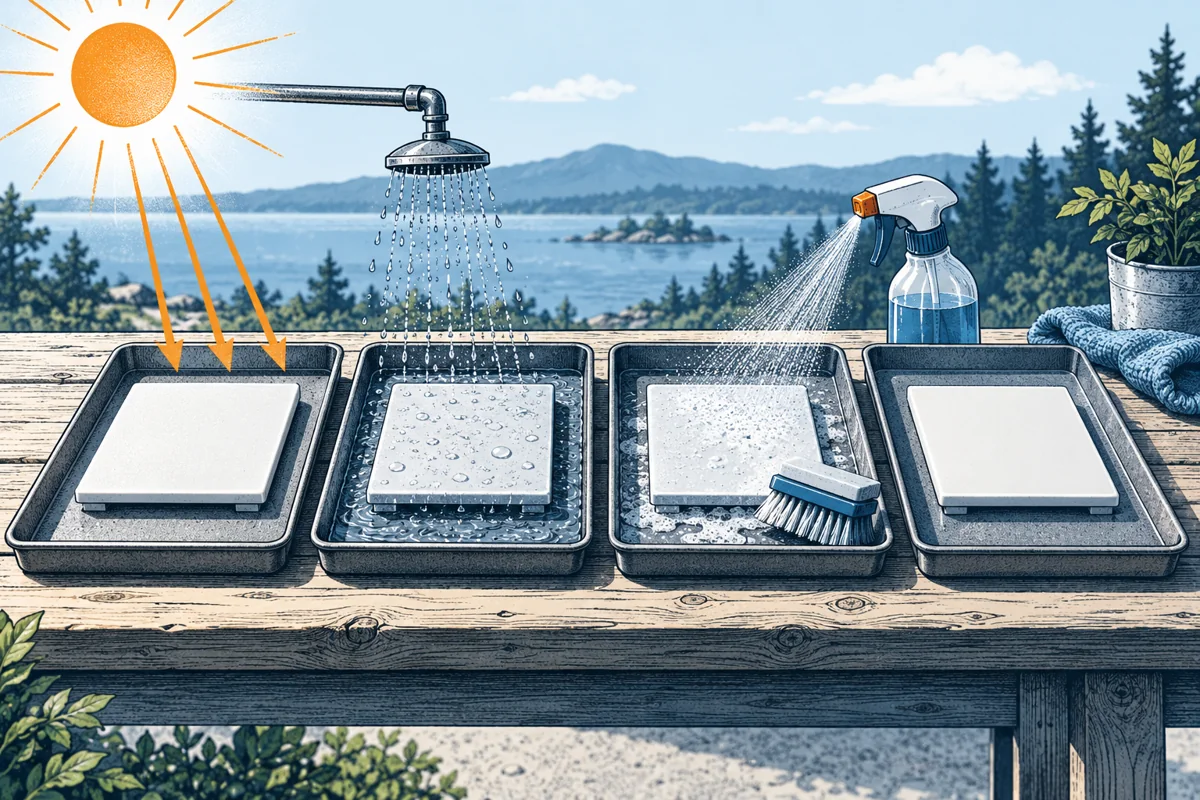
Outdoor use is several environments at once
A shaded patio accessory and a dark object on an exposed windowsill do not experience the same conditions. Neither is equivalent to a part repeatedly washed with a chemical cleaner. Describe the actual location, orientation, duration, wetting pattern, temperature range, and load before asking which plastic is best.
Protolabs' UV guidance notes that sunlight-related degradation can affect mechanical behavior as well as appearance. That makes visual inspection useful but incomplete. A part may retain its color while another property changes, or discolor without immediately losing its intended function. Define the failure you care about rather than treating all visible aging as equivalent.
Water resistance also needs context. Occasional splashes, standing water, humid storage, and repeated wet-dry cycles are different exposures. Material swelling, dimensional change, surface condition, and interaction with metal hardware may matter. A broad “weatherproof” claim compresses too many unanswered questions into one word.
Specify the exact material system
Record the grade, color, additives, reinforcement, and manufacturing process. A stabilized grade can differ meaningfully from a generic material in the same family. Pigments and processing choices can also affect performance. Ask the supplier which data apply to the exact proposed grade rather than to a similarly named resin.
Check whether the material is available in the form and quantity your process needs. An excellent injection-molding grade may not be available as filament or machinable stock. A printed approximation can support an early fit study while leaving outdoor-life validation unresolved.
Include finishes and joining materials. A coating, adhesive, gasket, or label may degrade before the structural plastic. If the product depends on that component, its failure belongs in the exposure plan. A durable shell alone does not establish a durable assembly.
A hypothetical garden-label holder
Suppose an inventor is developing a reusable garden-label holder. It must remain readable, retain its insert, and survive routine handling outdoors. The initial choice is based on an attractive printed material described as suitable for outdoor use. The inventor has no grade-specific exposure data.
The requirements are separated into legibility, insert retention, dimensional stability, and resistance to ordinary cleaning. The reference cleaner, dilution, contact time, and rinsing practice are recorded as actual intended-use conditions. Hazardous chemical testing is not improvised; supplier guidance or an appropriate lab is used where needed.
Representative samples include the full holder and insert, not only flat material coupons. An unexposed control is stored for comparison. Observations distinguish fading, cracking, warping, and loss of retention. If the insert falls out after wet-dry cycling, the relevant failure may be a dimensional or interface issue rather than UV degradation alone.
The inventor changes the retaining geometry and obtains a documented stabilized grade from the supplier. The revised study addresses both changes explicitly. A few weeks of outdoor exposure may reveal early problems, but it does not establish a multi-year warranty or equivalence to a standardized accelerated-weathering program.
Use screening data without overclaiming life
Supplier compatibility charts can eliminate obviously unsuitable candidates, but their conditions may differ from your application. Check concentration, temperature, duration, applied stress, and whether the data concern appearance, mass change, or mechanical properties. A chart entry without those details should not become a blanket product claim.
Accelerated weathering can be valuable when designed and interpreted correctly. A simple conversion from test hours to years outdoors is usually unjustified without a relevant model and exposure context. Different climates, orientations, and failure mechanisms complicate that relationship.
For early development, focus on comparing candidates under consistent conditions and identifying failure mechanisms. State the result as a comparative finding, not a lifespan guarantee. Use a qualified test provider when the intended claim requires a recognized method or a defensible service-life argument.
The outdoor-material decision file
Keep the exposure description, material identities, supplier evidence, test configuration, control samples, observation schedule, and acceptance criteria together. Photograph the same features under comparable lighting so appearance changes are not confused with photography differences.
Record any cleaning, handling, or storage between observations. A sample that was brought indoors during severe weather did not receive the same exposure as one left outside. If conditions deviate from the plan, retain the information instead of silently treating the results as equivalent.
The deliverable is a candidate material system with known evidence and remaining limits. That lets you improve the part, commission the right next test, and write product claims that match what was actually evaluated.