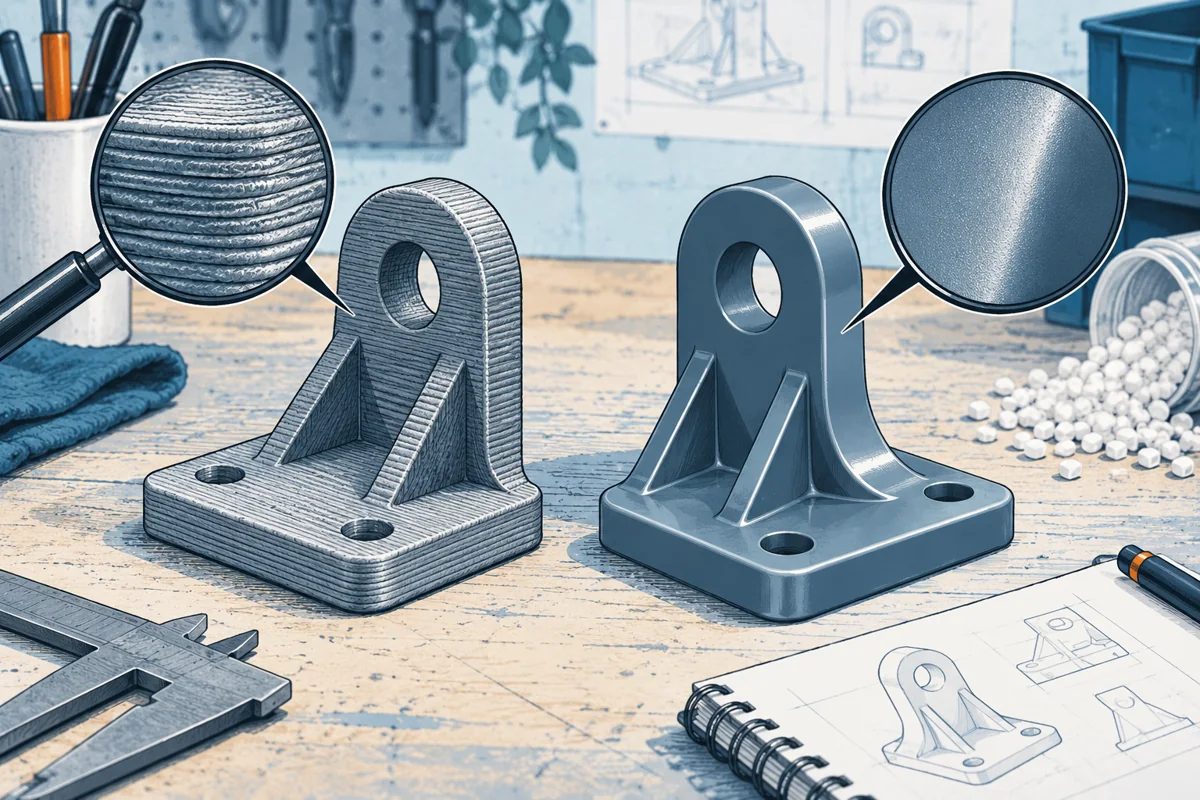
Similarity of feel is not material equivalence
A resin described as ABS-like may reproduce useful stiffness or appearance without matching all properties of molded ABS. A filament print made from a named thermoplastic still has a process structure and surface condition different from a molded part. The relevant question is not whether the names sound similar, but whether the property controlling your decision is represented.
Formlabs' end-use guidance discusses choosing materials and compensating for differences in properties. Its SLS design guidance also identifies directional differences for that process. These are reminders to evaluate the actual material-process combination rather than assuming that all printed parts behave the same way.
A prototype can remain extremely useful despite those limits. The mistake is extending a valid fit or interaction result into an unsupported claim about production durability. Preserve the useful evidence and name the gap instead of dismissing printing or treating it as a universal substitute.
Make an evidence-transfer map
List each question the printed prototype answered. Overall envelope, access to a control, visibility of a label, and assembly sequence may transfer reasonably if the relevant geometry remains unchanged. Even these can depend on mass, surface friction, flexibility, and tolerance, so identify the assumptions.
Mechanical questions usually need closer scrutiny. Layer orientation, support marks, post-cure, porosity, and local geometry can affect a printed part. Molding adds its own concerns, including shrinkage, flow-related behavior, gate locations, weld lines, and tool-dependent dimensions. A failure in one process does not automatically predict failure in the other, and success does not automatically transfer either.
Mark each result as transferable, conditionally transferable, or requiring new evidence. Add the reason and the proposed next test. This simple map prevents a development meeting from collapsing everything into the phrase “the prototype worked.”
A hypothetical snap-on cover transition
An inventor prints a cover and confirms that users can reach the release tabs and remove it without tools. The cover is intended to become an injection-molded product. The printed version survives a small number of demonstrations but has not been tested for repeated service.
The reach and sequence observations may remain relevant if tab location and surrounding geometry stay the same. Opening force may not transfer because material stiffness, friction, and dimensional variation can change. Snap life and retained fit over time are still open. The production design also needs draft and wall decisions that may alter the geometry.
A supplier proposes a molded grade and adjusts the wall transition. The inventor reviews whether the change affects finger access, then orders representative samples for the mechanical questions. The user study does not necessarily need to restart from nothing, but the affected interaction and force checks should be revisited.
If the molded samples behave differently, compare actual dimensions and process records before blaming material alone. A nominally identical snap can have a different strain because its dimensions changed. The transfer map helps identify which assumptions need correction.
Use coupons and parts for different purposes
Material coupons can support controlled comparisons and recognized test methods. Full parts capture the geometry, constraints, surface, and assembly conditions that determine product behavior. A strong coupon result does not prove a thin snap root is well designed; a working part does not necessarily provide a standardized material property.
For early screening, consistent printed coupons may help compare orientations or post-processing conditions within one process. Keep that conclusion within its scope. Do not label it as the molded material's property unless the method and material support that statement.
When the intended application has significant consequences, obtain an appropriate engineering and test plan. Production qualification, regulatory evaluation, and material certification have specific meanings. A prototype comparison should not borrow those labels merely because it uses measurement equipment.
Plan the transition before tooling
Ask the molding supplier to review the geometry, grade, critical dimensions, and test requirements while changes are still inexpensive. Identify which printed features are difficult to mold and which molding changes could affect already-tested behavior. Keep the design, material, and process decisions connected.
Your transition checklist should include exact grade, representative geometry, expected process differences, critical measurements, affected user tasks, and required mechanical or environmental tests. Retain the printed build record so differences can be explained later.
The deliverable is a staged validation plan that uses printing for what it can establish and reserves production-like evidence for the questions it cannot. That approach reduces unnecessary testing while avoiding confidence based on a material resemblance rather than a demonstrated equivalence.