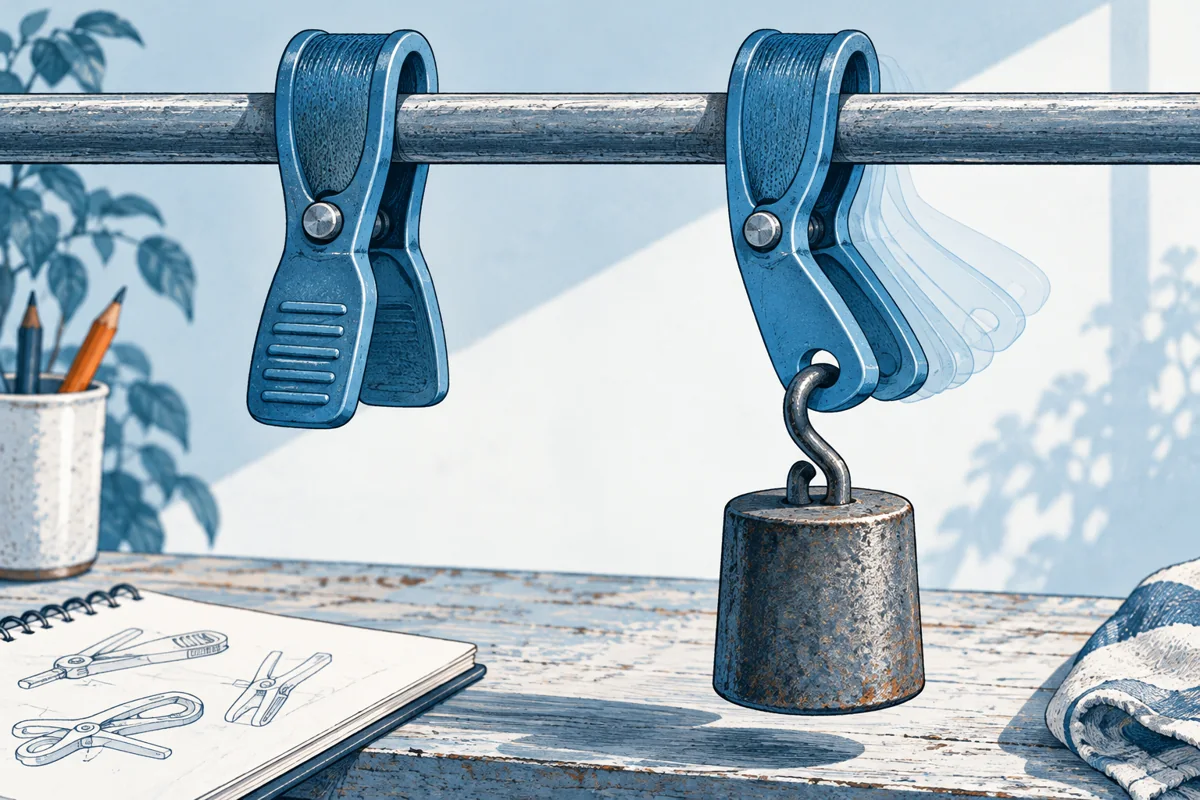
The first successful use may miss the controlling behavior
An inventor tests a clip immediately after assembly and finds adequate retention. Several days later it slips. The original result may have been accurate for that moment, but it did not address time-dependent behavior. Plastics can respond differently to a short loading event and a long period under deformation.
Creep broadly describes increasing deformation under sustained stress. Stress relaxation describes decreasing stress when deformation is held approximately constant. A clip held open around an object can experience relaxation, while a loaded arm can progressively deflect. Real parts may combine those effects with wear, temperature changes, or damage.
Material-selection references such as Formlabs' guide distinguish short-term mechanical properties from other performance measures. A tensile-strength value alone cannot predict how much clamping force remains after a particular time. Seek grade-specific information relevant to sustained loading and confirm it in the actual geometry.
Diagnose the load condition and the evidence
Photograph and measure the clip before loading, during the hold period, and after unloading under consistent conditions. Record whether the opening changes permanently, whether recovery occurs, and whether visible cracks or whitening appear. Use a measurement method suitable for a compliant part; squeezing it with a tool can change the value you are trying to observe.
Keep an unloaded control made with the same process. If both loaded and unloaded samples change, storage, post-processing, or environmental conditioning may be involved. If only the loaded sample changes, the load history becomes more likely to matter. This comparison narrows causes but does not replace material analysis when the consequence is significant.
Track temperature. A part near sunlight, an appliance, or enclosed electronics may experience conditions different from the room where it was first tested. Do not infer its temperature from ambient air alone when local heating is plausible. Use appropriate measurement and avoid improvised hazardous heating experiments.
A hypothetical desk-cable clip investigation
Suppose a printed clip holds a light cable with a wide initial opening deflection. The inventor makes six identical samples from one controlled build. Three remain unloaded and three are installed on the same reference cable. This small study is exploratory, not a statistical reliability demonstration.
At predefined times, the inventor records opening geometry and a consistent retention observation. After several days, the installed clips show reduced retention, while the unloaded controls remain closer to their initial geometry. After removal, the installed clips partially recover. That pattern is consistent with time-dependent deformation, but the precise mechanism would require more evidence.
The designer reduces the sustained deflection by changing the relaxed geometry and uses a separate feature to guide insertion. A second set is tested under the same conditions. If retention improves, the geometry change may have reduced the problematic strain. The inventor still needs to check opening effort and repeated-use damage; improving one behavior can worsen another.
A material substitution is evaluated separately rather than changing both geometry and grade at once. Otherwise a better result would not show which change mattered, making future production choices harder to justify.
Design changes that address the cause
Reducing sustained strain can be more effective than making the clip thicker. Increasing thickness may increase stiffness and local strain for a prescribed displacement, depending on geometry. Analyze the actual flexing region rather than assuming more material always helps.
Consider whether retention can come from geometry instead of continuous spring force. A positive engagement feature, a replaceable elastic element, or a different load path may reduce dependence on long-term polymer stress. Each alternative introduces its own usability, assembly, and failure questions, so treat it as a design option to evaluate rather than a universal fix.
If changing material, compare relevant grade-specific data and process compatibility. A resin described as tough or high-temperature may still lack suitable long-term behavior for your configuration. Ask the supplier about the exact sustained-load condition and record any unanswered questions.
Define a useful hold test and its limits
Specify the installed geometry, reference object, load or deflection, temperature conditions, observation intervals, and failure definition. Include the post-unloading recovery observation if it helps distinguish mechanisms. Keep sample identities and build records so a later material or process change can be recognized.
Avoid claiming service life from an arbitrary accelerated test. Raising temperature or load may change the failure mechanism rather than simply speed it up. Translating a short harsh test into years of normal use requires a justified model and relevant expertise.
The deliverable is a time-history record and a design decision: reduce strain, change the retention approach, investigate another grade, or obtain more specialized testing. A clip that works once has passed an initial-function check. A clip that retains function over the intended exposure needs separate evidence.