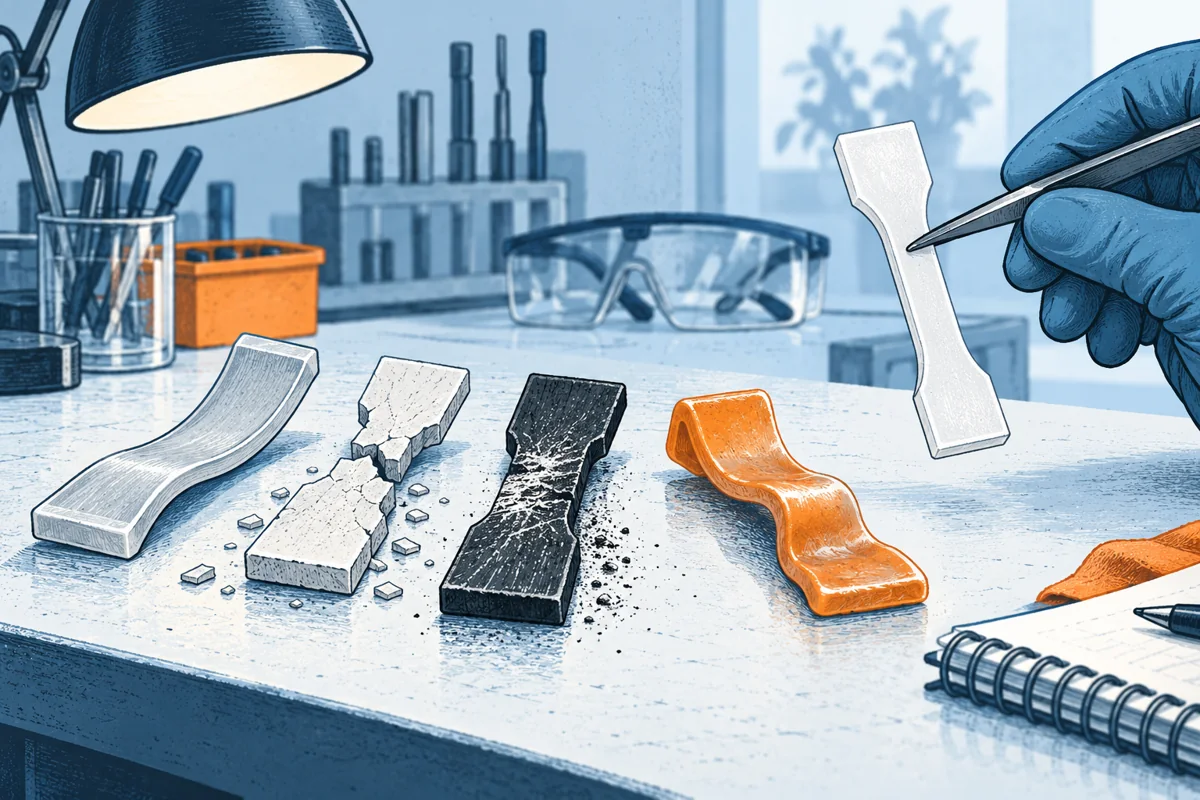
Translate “strong” into a failure you want to prevent
A rigid bracket, a flexible snap, and a dropped enclosure need different properties. Stiffness describes resistance to elastic deformation. Strength concerns stress before a defined failure or yield condition. Toughness and impact behavior concern energy absorption and fracture under particular conditions. Treating those properties as interchangeable leads to disappointing prototypes.
Start with the load case and failure consequence. Does the part need to stay dimensionally stable, spring back after bending, avoid cracking after impact, or maintain force over weeks? Identify temperature, moisture, sunlight, cleaning chemicals, and contact duration. These conditions can change which property is controlling.
Formlabs' material-selection guidance distinguishes properties including tensile behavior and heat deflection. Use such references to understand the terms, then obtain the current data for the exact material and process you intend to purchase. A broad polymer-family name is only the beginning of a selection.
Separate material identity from manufacturing route
An injection-molded thermoplastic, a filament print, and a photopolymer resin described as similar to that thermoplastic are not automatically equivalent. Their structure, processing, surface condition, and time-dependent behavior can differ. A prototype material may reproduce the feel of a production candidate while failing to reproduce its fatigue or temperature response.
Record the process along with the material: grade, supplier, orientation where relevant, post-processing, and conditioning. For printed parts, build settings and geometry can materially influence behavior. For molded materials, additives and reinforcement can affect flow, shrinkage, and mechanical response. Do not transfer a data-sheet value to a finished part without considering those differences.
Ask whether the experiment needs production-like material behavior at all. A fit-only model may use a convenient stable material. A snap-life experiment needs a much stronger argument for representativeness. Spend the material budget on the behavior under investigation rather than demanding realism in every property.
A hypothetical clip with two competing candidates
Suppose a clip must hold a light cable against a desk and open repeatedly by finger pressure. Candidate A feels very stiff and holds the cable firmly on the first try. Candidate B bends more easily. Selecting A because it feels stronger ignores the possibility that the repeated bending strain is too high at its root.
The inventor lists the relevant questions: initial retention, opening effort, recovery after repeated use, and retention after remaining closed for an extended period. A short pull test answers only the first. A controlled repeated-use sequence addresses another. A sustained-load study explores whether the grip relaxes. The exact loads and durations must come from the intended application.
If A cracks early while B retains useful function, B may be better even though its nominal tensile strength is lower. Alternatively, B may survive flexing but lose grip over time. The next step might be a geometry change rather than a search for a universally superior plastic.
All of these observations belong to the tested grade, geometry, process, and conditions. They do not establish that every material in the same family will behave similarly, or that a later molded version will match the printed prototype.
Build a selection matrix with disqualifiers
List essential conditions first: temperature range, exposure, required deformation, dimensional stability, and manufacturing compatibility. A candidate that fails an essential condition should not win through an average score inflated by low price or attractive finish. Use weighted comparisons only after basic constraints are satisfied.
Record missing data as unknown, not zero risk. Ask the material supplier for relevant long-term, chemical, or environmental information when the intended use depends on it. A technical data sheet may contain short-term laboratory results but no evidence for your particular combination of load and exposure.
Include fabrication and inspection practicality. A promising grade may be unavailable in the required stock form, difficult to process at the chosen supplier, or inconsistent with a thin feature. A material selection that cannot be manufactured reliably is incomplete. Request a process review before freezing the design.
Document the selection and the next test
Keep a one-page record showing the failure mode, candidates, data sources, assumptions, reasons for elimination, and planned confirmation. Include exact grade names and dates of the data sheets. If you later substitute a material, revisit the reasons the original was chosen.
Test the representative part as well as convenient coupons when geometry matters. A coupon can compare material behavior under a controlled method, but a real latch includes stress concentrations, surface conditions, and assembly constraints. Neither type of test replaces the other in every situation.
Your deliverable is a justified candidate and an explicit validation plan, not a claim that a material is safe for every use. Selection narrows uncertainty; testing the actual configuration establishes the evidence you can responsibly carry into the next design stage.