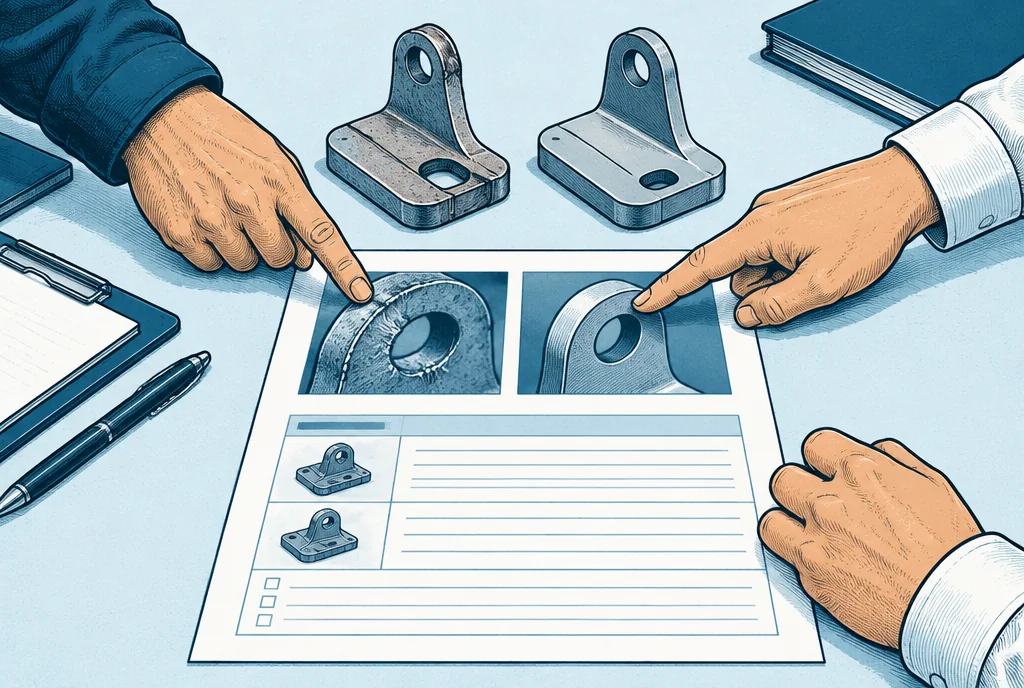
Make the problem specific enough to investigate
A message saying the parts are bad gives a supplier little basis for action. Identify the requirement that is not met and the observed result. Include the drawing revision, lot or shipment, affected quantity, measurement method, and photographs where useful. Preserve representative defective parts.
Distinguish a confirmed nonconformance from a disputed interpretation. If the drawing is ambiguous or your measurement method is uncertain, state that. Resolving the definition may be part of the corrective work. Accusing the supplier before checking the controlling files can delay a useful investigation.
NIST's supplier-selection guidance includes production and inspection documentation as part of supplier evaluation. Recurring quality issues are another reason those records matter: they help connect a symptom to the process that produced it.
Separate containment, correction, and prevention of recurrence
Containment addresses material that may already be affected. That can include identifying lots, holding stock, and agreeing on screening or other disposition. The appropriate action depends on the defect and consequence; it should not be improvised by mixing suspect and accepted parts.
Correction addresses the immediate nonconforming product, such as an approved rework or replacement. Corrective action addresses the cause so the problem does not recur. A replacement shipment may be necessary, but it is not evidence that the process changed effectively.
Ask the supplier to explain the proposed cause and supporting evidence, the change made, and how effectiveness will be checked. A promise that operators will be more careful is weak when the actual issue is an unclear setup, wrong revision, unstable fixture, or inadequate inspection method.
A hypothetical recurring slot-width defect
An inventor receives two successive lots with some slots narrower than the drawing permits. The first lot was replaced, but the problem returns. The inventor sends a record showing lot identities, sample measurements, the agreed method, and photographs of the functional interference.
The supplier first identifies potentially affected stock and agrees on a disposition. Investigation shows that the setup instruction references an obsolete offset and that final inspection checks only overall dimensions. The proposed action therefore includes correcting the setup reference and adding the slot to the relevant inspection plan.
The next lot includes identified measurements from the agreed check. The inventor performs the planned receiving verification and records whether the original defect recurs. If the parts pass, that supports effectiveness for the observed production; continued monitoring may still be appropriate for a recurring or consequential issue.
This response is stronger than asking for a discount or another replacement alone. It connects the defect to a process cause and a control intended to detect or prevent recurrence. The commercial remedy and the technical correction can be handled separately.
Verify the action against the original failure mode
Define effectiveness criteria before the next shipment. The criteria should concern the defect that triggered the request, not merely whether the supplier sent a revised procedure. A procedure is evidence of an intended change; actual production and inspection results show whether it worked in the observed case.
For infrequent production, the next opportunity may be months away. Keep the issue in a status such as action implemented, effectiveness pending rather than pretending the absence of new orders proves success. Record which future lot or event will supply the evidence.
If the supplier changes material, equipment, subcontractor, or method, assess whether other requirements are affected. A cure for one defect can introduce another. Update the agreed manufacturing package and affected checks rather than accepting an undocumented process substitution.
Use escalation proportionate to the issue
A first minor issue may be resolved through a concise factual exchange. Repeated, serious, or poorly explained issues justify a more formal corrective-action record and closer review of supplier suitability. Define expectations and dates appropriate to the actual production schedule.
Track recurrence, response quality, inspection evidence, and the cost of disruption. Do not reduce supplier performance to on-time delivery alone. A supplier that ships promptly but repeatedly requires sorting can impose substantial hidden cost.
Your deliverable is a closed loop: defect evidence, containment, cause investigation, corrective change, and effectiveness verification. Close the issue when the agreed evidence exists, retaining any limits. That creates a fair and practical basis for continuing, changing the supplier relationship, or revising your own specification where it contributed to the problem.