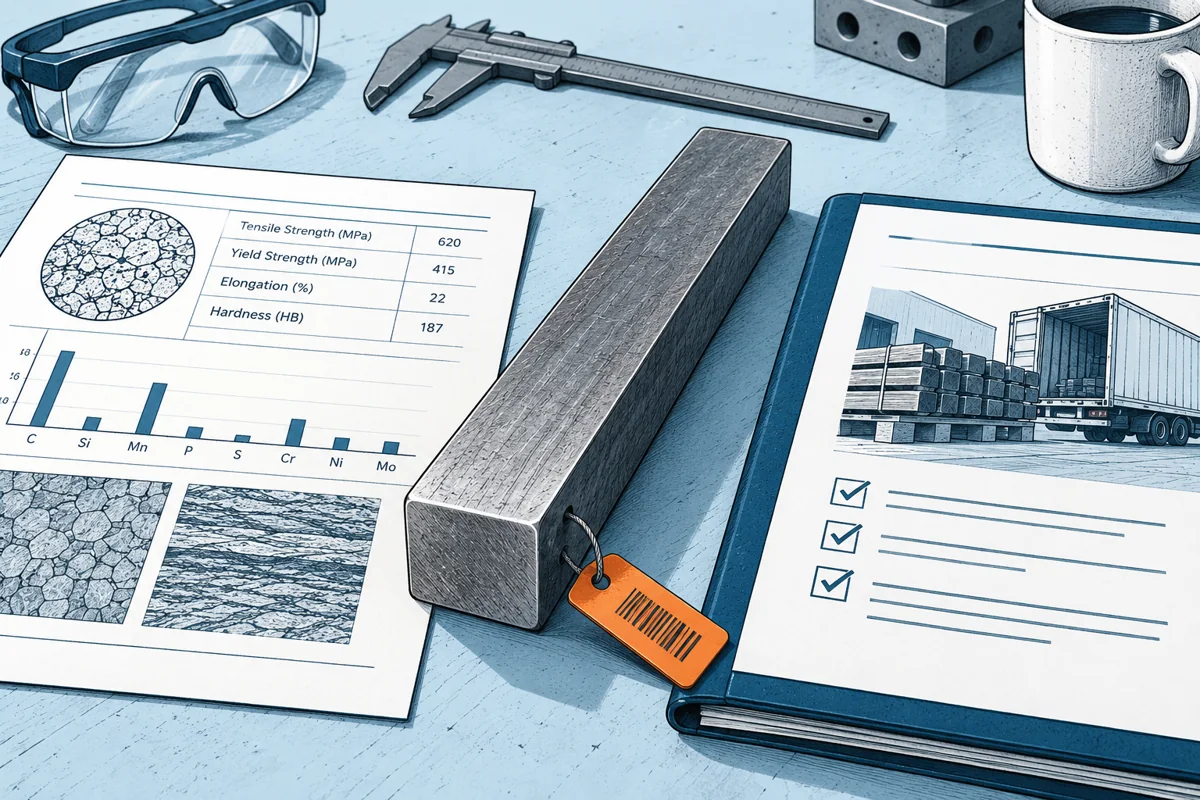
Read the evidence, not only the document heading
A document called a material certificate may identify a grade, provide test results, or contain a supplier statement with limited detail. A certificate of conformance may refer to an order or specification without including actual measurements. The title is a starting point for review, not a complete description of evidentiary value.
Protolabs' quality-assurance offerings distinguish material certificates, material test reports, dimensional reports, and first-article inspection. Those categories illustrate why the requested evidence should match the question. If you need to know an actual dimension, a general conformance statement may be insufficient.
Ask what requirement the document supports and how it connects to the delivered parts. A correct certificate for a different material lot does not establish the identity of your shipment. Traceability depends on the chain of records, not the appearance of an official-looking PDF.
Choose documents from the design requirement
If the design depends on a specified alloy and condition, identify the material evidence required and discuss availability before purchase. If it depends on a finish, determine what finish documentation or testing is appropriate. If the concern is a critical dimension, request the relevant inspection report.
Do not request every possible certificate without a purpose. Documentation can add cost and lead time, and some evidence cannot be reconstructed after production. A focused requirement is more useful than a vague demand for all certifications.
Keep supplier-system credentials separate from product evidence. A supplier's quality-system certification may inform selection, but it does not prove that a specific part meets your drawing or that your complete product has passed an applicable evaluation. Verify the scope and current status when relying on such credentials.
A hypothetical aluminum component shipment
An inventor orders a small aluminum locating component whose drawing specifies an alloy and condition. The shipment includes a certificate of conformance referring to the purchase order. The inventor also needs the material evidence agreed in the order, but the attached mill document has no obvious link to the delivered lot.
Rather than assuming fraud or accepting the paperwork uncritically, the inventor asks the supplier to explain the traceability chain. The supplier provides the internal lot reference connecting the stock material to the manufacturing batch. The inventor checks that identifiers, grade, and relevant dates are consistent.
A dimensional report then shows the locating feature's measured value. That report answers a different question from the material record. Both may be necessary for this part, while neither establishes that the assembled invention performs its intended task.
If the requested material record was never included in the original scope, the supplier may be unable to reconstruct it reliably. This is why documentation requirements belong in the RFQ and order, not as an afterthought when a customer asks for proof.
Check for gaps and contradictions
Review issuer, document date, part or order reference, revision where relevant, material or process identity, lot linkage, and the requirements covered. Look for contradictory identifiers, unexplained substitutions, or missing pages. Ask for clarification on ambiguous fields instead of filling them with assumptions.
If a report includes numerical results, confirm units, method, and acceptance limits. A test value without its method or scope may not support the intended conclusion. For critical decisions, involve someone qualified to interpret the particular material or compliance evidence.
Do not alter supplier records to make them appear complete. Keep the original and attach clarifications or corrected documents issued through the appropriate process. Your records should show what was provided and how gaps were resolved.
Build a documentation matrix for repeat orders
Use a row for each required document and columns for purpose, required fields, responsible supplier, timing, and storage location. Link the received document to the relevant lot and inspection record. This makes missing evidence visible before parts enter use.
For repeat orders, confirm that documentation requirements remain in the accepted scope. A previous supplier accommodation may not automatically carry forward to a new quote or subcontracted process. Review substitutions and process changes for their effect on the evidence needed.
The deliverable is a small, coherent evidence package that supports specific claims about the delivered parts. It avoids both extremes: collecting impressive paperwork with no practical meaning, and assuming that a generic certificate proves everything the design requires.
Preserve the link when splitting a shipment
If one incoming lot is divided into smaller storage containers, carry its identifier onto each container and retain the document reference. Otherwise a well-documented shipment can become untraceable during ordinary handling. The same principle applies when parts are sent to another vendor for finishing: preserve the connection between the incoming material and returned parts.