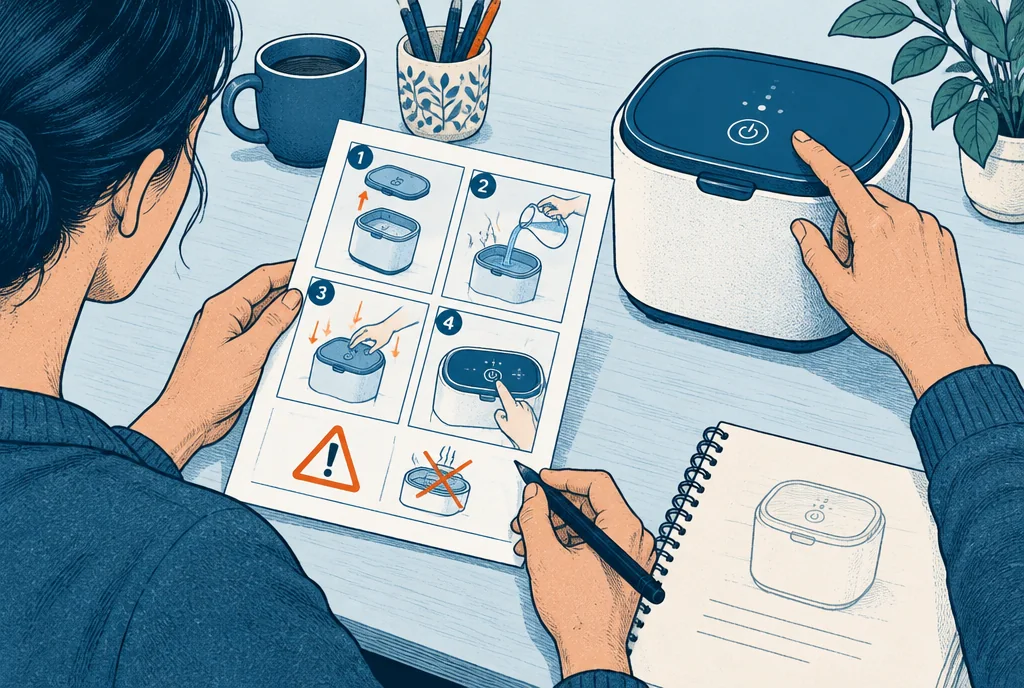
Start with the task, not the sales description
A product manual should help someone unpack, inspect, assemble, operate, maintain and eventually dispose of the product as appropriate. Marketing copy describes why the invention is desirable; instructions explain what the user must do. Copying the product listing into a leaflet leaves important transitions unexplained.
Observe the task with a safe model or appropriate reviewed sample. Note the user's starting state: are parts still packaged, is power disconnected, is a component already attached? Instructions that assume an unstated starting condition can be misunderstood even when each sentence is grammatically clear.
Build the document from a hazard and task review
Create a task list with the required action, expected result and relevant limit for each stage. In a separate column, record foreseeable errors. Bring that list to the people responsible for safety evaluation so the document reflects the actual design controls and remaining risks.
CPSC's manufacturing best-practices page points businesses toward its guide to developing consumer-product instructions. The hazardous-substance labeling FAQ illustrates that some product categories have specific requirements for warning content and prominence. Those provisions are not a universal template for every product. Determine which rules apply to yours rather than borrowing a warning panel from unrelated packaging.
Separate mandatory labeling from helpful supplementary instruction. Both need to be correct, but an attractive online manual may not replace information required on the product or package. Resolve location, language, legibility and durability questions with the appropriate reviewer.
Write a step someone can verify
Use one main action per step when sequence matters. Name the actual part, state the action and describe the visible or measurable result. Avoid “install correctly,” because it gives the reader no way to tell whether the step is complete. Define unfamiliar terms at first use and use the same name consistently thereafter.
Illustrations should show the relevant orientation and omit distracting detail. Match part labels in the drawing to the parts list. If left and right depend on the user's viewpoint, establish that viewpoint explicitly. Do not rely on color alone to convey an important distinction.
Warnings should be developed with competent safety input. Explain the relevant hazard and avoidance action in the form appropriate to the product and applicable requirements. More warnings are not necessarily better: a wall of generic cautions can hide the few actions that matter most.
A worked example: an ambiguous locking indicator
Suppose a folding organizer has a red mark visible before the latch is fully seated. The draft instruction says “close until secure.” In a safe usability walk-through, readers disagree about what secure looks like. The problem may require a design change as well as better words.
The team revises the indicator and prepares a drawing that shows the accepted and unaccepted positions. The step describes the observable completion condition reviewed for that design. A subsequent session checks whether new readers understand it without a facilitator pointing to the right picture.
This example is not a specification for a load-bearing device. Its lesson is that a misunderstood instruction can expose a design ambiguity. Rewriting the sentence alone is not always the appropriate correction.
Test comprehension without teaching the answer
Give a representative reader the materials they would receive and ask them to explain the next step or demonstrate it under safe, reviewed conditions. Do not begin with a verbal tutorial that compensates for missing documentation. Record where they pause, skip a warning, misidentify a part or expect a different result.
Ask open questions such as “What tells you this step is finished?” A yes-or-no question like “Was that clear?” often produces reassurance rather than evidence. Treat the session as a check of the document and design, not a test of the reader's intelligence.
If a misunderstanding could expose someone to harm, stop and revise the study conditions. Comprehension research does not justify asking participants to carry out hazardous steps on an unreviewed prototype.
Control revisions through production
Assign an identifier to the manual and each label. Link them to the product configuration they cover. When a part, control or maintenance interval changes, include documentation in the change review. Otherwise, the factory may ship a new mechanism with old pictures.
Keep a master version and an approval record rather than exchanging unnamed PDFs by email. Check the printed size, contrast and folding or packaging arrangement on a physical sample. A warning that looks clear on a large monitor can become unreadable on the delivered product.
Provide a stable way to find current instructions, but do not assume a QR code alone satisfies product-specific requirements. If older product versions need different instructions, label those versions clearly so an owner does not apply the wrong procedure.
What to hand off
The release package should include the approved manual, label artwork, revision compatibility list, print requirements and evidence of the review performed. Add a process for reporting confusing instructions and reviewing recurring support questions. Documentation remains part of the product after launch; customer misunderstandings are evidence to examine, not merely tickets to close.