Decide what you actually need to learn
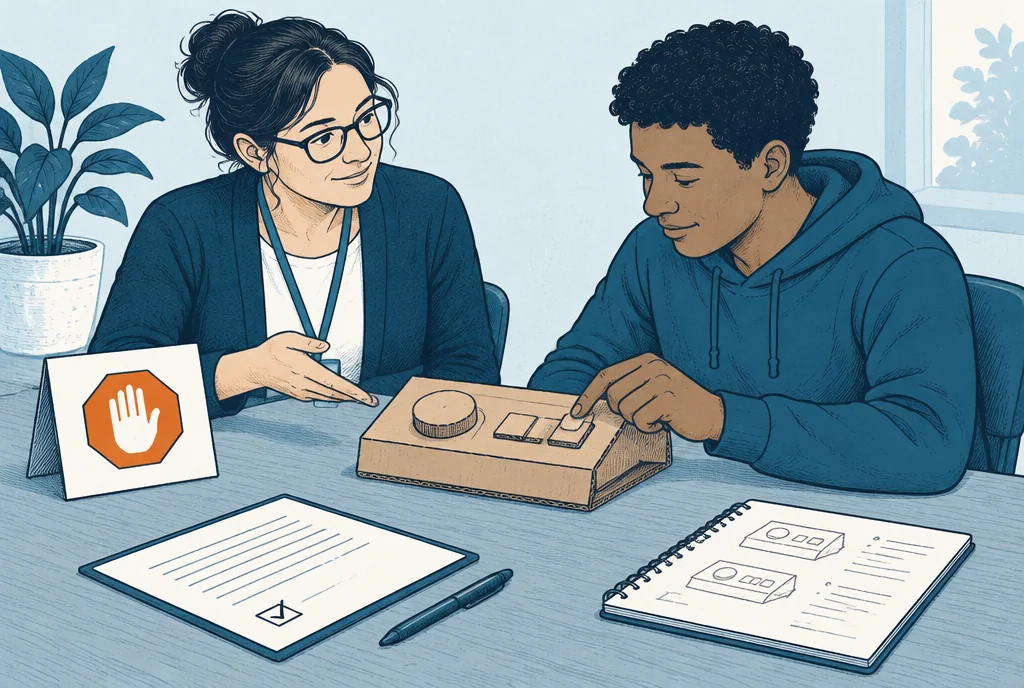
A user trial can investigate grip comfort, comprehension, task sequence or performance. These are different questions and do not require the same apparatus. If you only need to know whether a handle is reachable, an inert mock-up may provide useful evidence without exposing anyone to a moving mechanism.
Write a sentence beginning “We need to observe whether…” and finish it with a behavior you can see. Replace “see if people like it” with something narrower, such as whether a person can identify the release control without prompting. Keep aesthetic feedback separate from claims that the device performs safely under load.
Draw the boundary of the trial
Describe the location, participants, supervision, permitted actions and prohibited actions. Account for foreseeable mistakes rather than expecting everyone to follow your demonstration perfectly. A control that can be confused with another control is a design finding, not simply participant error.
Identify hazards from motion, stored energy, electricity, heat, chemicals, sharp edges, loads and the environment. Also consider information risks: photographs, recordings and personal details should be collected only when needed for the study and with appropriate permission. Product categories involving health, children or other vulnerable participants require specialist guidance, not an improvised informal trial.
Use the CPSC manufacturing guidance as a starting point for thinking about product safety. It is not authorization for human testing. Where the trial could cause meaningful harm, obtain suitable professional review and determine applicable legal or institutional requirements before recruiting participants.
Use staged exposure
Start with a desk review and an inert walk-through. Next, have qualified people evaluate the relevant mechanisms under controlled conditions. Only introduce ordinary participants when the specific trial conditions have been reviewed and accepted. The sequence can stop or return to design work at any stage.
An inventor sometimes wants users to try a fully functional sample because it looks impressive. That can mix several unverified assumptions into one event. Test the interface separately from a high-energy function when possible. You can learn whether instructions are confusing without asking someone to operate the dangerous part.
Never defeat guards or protective systems to make a demonstration easier. If a proposed experiment requires that, redesign the experiment with a qualified specialist. The question may be answered through simulation, observation of a safe substitute or a properly equipped laboratory instead.
Prepare stop conditions before the session
List observable events that end the trial immediately: unexpected movement, abnormal heating, damaged components, discomfort, confusion that creates exposure or a participant asking to stop. Give the facilitator authority to end the session without negotiating with the inventor. Describe the safe shutdown method and who is qualified to perform it.
Record the sample's revision and condition before every session. A replacement part can invalidate assumptions made during the earlier review. Avoid treating yesterday's uneventful demonstration as proof that today's modified prototype is acceptable. Schedule inspection between sessions when the mechanism can wear or loosen.
Explain what the participant will do, what information will be collected and how to stop. Do not describe the device as certified or approved unless that claim is accurate for the exact configuration and use. Obtain appropriate consent, but recognize that consent is not a substitute for risk controls or an assessment of legal duties.
A worked example: testing a folding stand
Consider a hypothetical folding display stand with a new latch. The inventor wants to know whether users understand when it is locked. The first trial uses a non-load-bearing mock-up, so the researcher can observe the sequence and ask the person to explain the indicator.
Several people interpret a half-closed position as locked. The finding changes the indicator and latch design before a loaded trial is considered. Asking participants to lean on the original device would have added risk without providing better evidence about the misunderstanding.
After redesign, a qualified reviewer defines the mechanical evaluation needed before the next stage. The usability record does not become a load-rating certificate. The two forms of evidence answer separate questions and remain separate in the project file.
Turn observations into design actions
For every important event, record the task, observed behavior, sample revision and consequence. Distinguish an observation from your explanation. “Participant pressed the wrong control twice” is an observation; “the label was too small” is a hypothesis that needs checking.
End with three lists: design changes, questions for the safety reviewer and questions for the next usability session. Keep recordings access-limited and retain only what the study needs. A useful trial reduces uncertainty without creating an unjustified exposure, and its conclusions stay within the conditions actually observed.