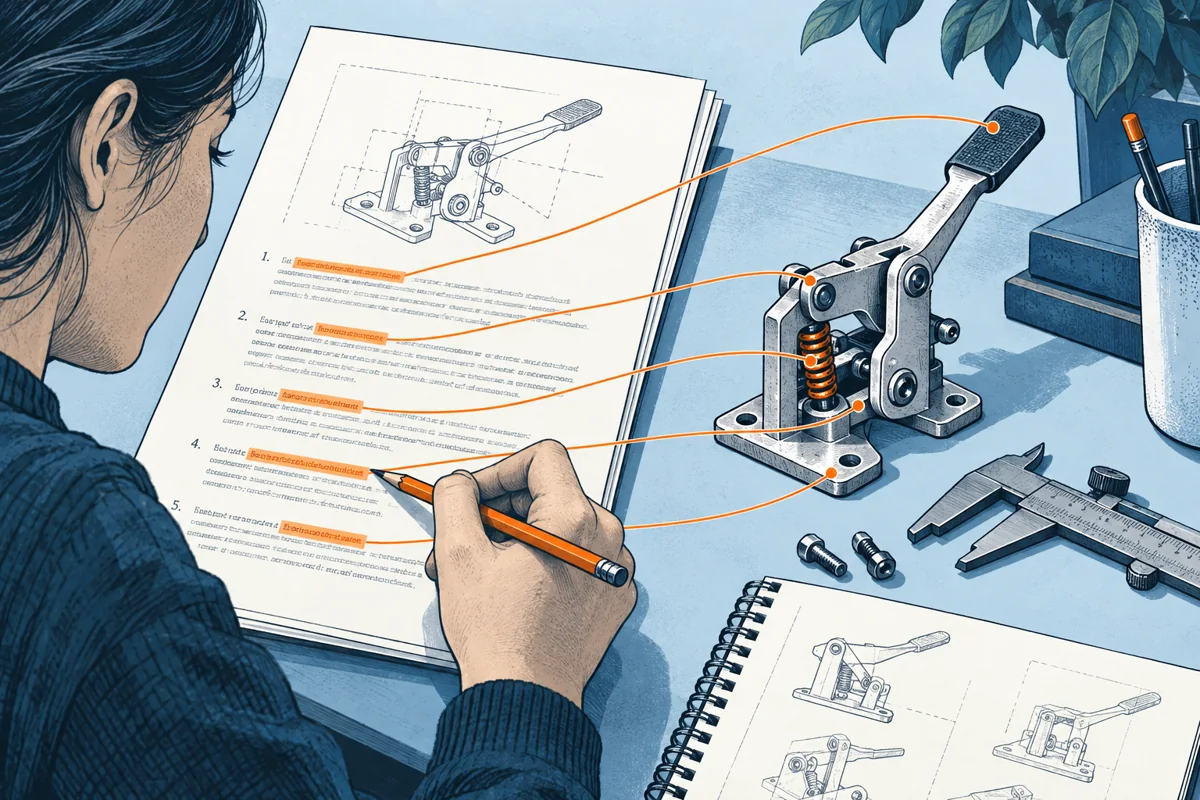
Know which part of the document you are reading
A patent's title and abstract provide orientation. Drawings and the written description explain examples and terminology. Claims define the legal subject matter at issue. A drawing that resembles your prototype is a reason to investigate, not a complete answer about infringement or patentability.
WIPO: Patent frequently asked questions explains patent rights at a general level. WIPO: Freedom to operate describes why freedom-to-operate work goes beyond finding similar documents. This article offers a reading method for organizing questions, not a legal opinion about any claim.
Identify the document and its status
Record whether you are looking at a published application or an issued patent, its jurisdiction, publication number and the version of the claims. Application claims may change. Related applications may contain different claims. A commercial decision cannot rest on a screenshot of an abstract with no date or document identity.
For a first technical comparison, preserve the exact claim text in your private worksheet and its source. Do not paraphrase away a limitation because it seems minor. For public writing, summarize carefully and link to the document rather than copying long passages unnecessarily.
Break an independent claim into a checklist
- Find the subject. Is the claim directed to a device, method, system or another category?
- Separate the elements. List each component or step without deciding yet whether your product has it.
- Capture relationships. Words describing attachment, sequence, position or interaction may matter as much as component names.
- Flag unfamiliar terms. Read how the specification uses them and record uncertainty.
- Map evidence. Link each proposed correspondence to a drawing, measurement or documented operation of your design.
- Read dependent claims. Include the limitations of the referenced claim as well as the additional wording.
A fictional claim-reading exercise
Imagine a fictional claim describing a container support with a base, two pivoting arms attached to the base, and a latch that holds the arms in an open position. This is not a real patent claim. Your prototype has a base and two arms, but the arms flex rather than pivot and an elastic band holds them apart.
A beginner may say “different latch, so no problem.” A better worksheet records the uncertain terms: what does “pivoting” mean in the actual document, how is “latch” used, and what relationships are required? It also records the exact prototype structure. Those questions need legal interpretation before any clearance conclusion.
If a dependent claim adds a removable wall mount, a product lacking that mount may still require analysis under the broader independent claim. Reading only the narrowest-looking example can create false reassurance. Conversely, seeing a generic component such as a spring does not mean every spring-based product falls within the claim.
Build a comparison table without issuing a verdict
| Claim limitation | Proposed product evidence | Initial observation | Question |
|---|---|---|---|
| Base supporting arms | Assembly drawing A | Apparently similar structure | Does the claim require a particular relationship? |
| Pivoting connection | Flexible molded hinge | Meaning uncertain | How is pivoting interpreted? |
| Latch retaining open position | Elastic band | Different described mechanism | What legal scope applies? |
Use labels such as “appears present,” “not identified” and “requires interpretation.” Avoid labeling a column “safe” or “infringing” unless qualified analysis supports that conclusion. The purpose is to reduce ambiguity before a professional review.
Common reading failures
One failure is treating every detail in a drawing as a claim requirement. Another is treating the abstract's broad description as the enforceable boundary. A third is ignoring method claims because the product is a physical object. How the product is used can raise questions separate from its construction.
Also avoid relying on an automated summary alone. A summary may omit a relationship or merge several claims. Use software to organize the text if helpful, but verify the original record. Keep uncertainty visible instead of turning a confident-looking summary into a legal conclusion.
What to send a practitioner
Provide the exact patent or application, your dated product specification, the feature table, target countries and planned activities such as manufacture, import or sale. Identify which design decisions remain flexible. This lets advice focus on the actual product rather than a vague concept that may change next week.
Ask whether related family members, prosecution history, status and other patents need review. A single document rarely defines the entire landscape. Educational reading helps you ask better questions, but it does not replace a patentability or freedom-to-operate assessment.