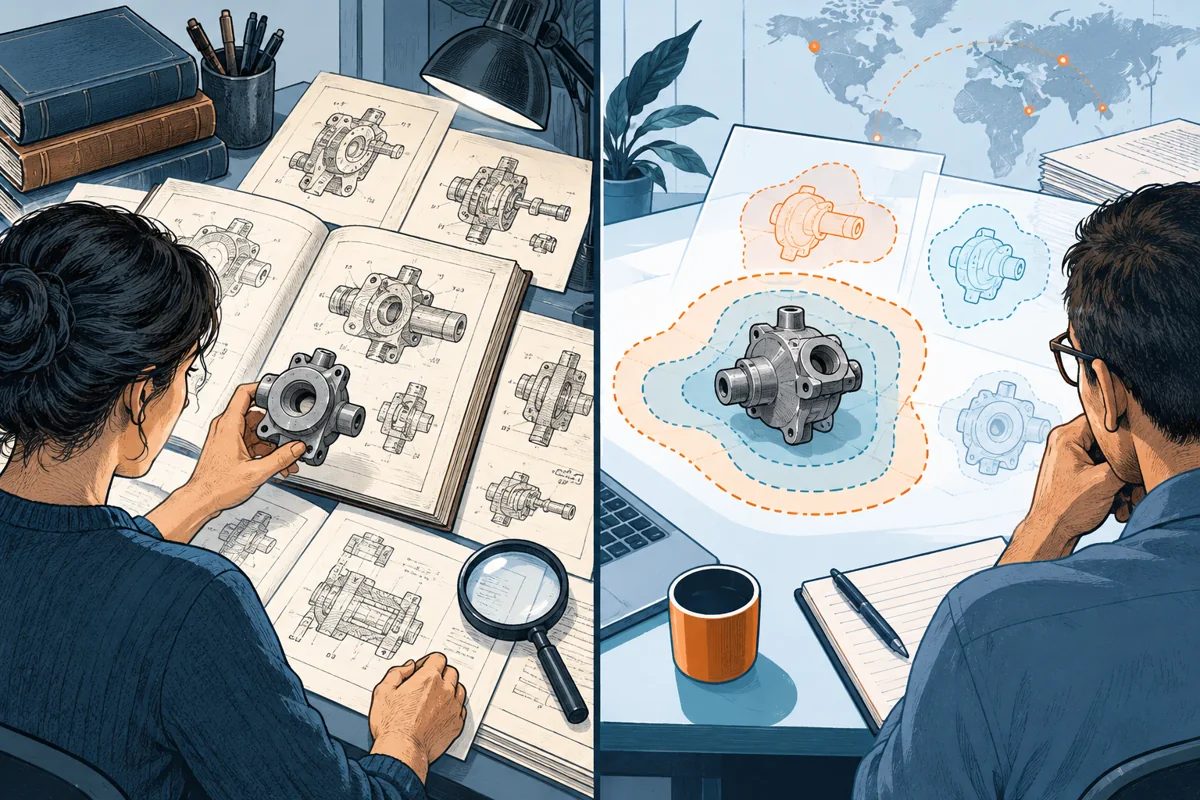
Write the legal question before buying a search
“Can I patent this?” and “Can I sell this?” are not interchangeable questions. The first concerns protection you may obtain. The second concerns rights others may hold over activities you plan to perform. A report labeled simply “patent search” can be misunderstood unless its purpose and limits are explicit.
WIPO: Freedom to operate explains the clearance concept, while USPTO: Managing a patent notes that patent rights do not themselves guarantee the ability to practice an invention. The examples below are educational and do not resolve any specific infringement or patentability question.
Compare the two assignments
| Dimension | Patentability investigation | Freedom-to-operate investigation |
|---|---|---|
| Main question | What earlier disclosures affect proposed claims? | What relevant rights may affect planned activities? |
| Starting material | Invention disclosure and possible distinctions | Defined product, process, territories and timing |
| Useful records | Patents and non-patent disclosures | Relevant claims, status and related records |
| Typical output | References and assessment of patentability issues | Bounded risk analysis and possible options |
| Common false conclusion | No result means guaranteed patent | Own patent means permission to sell |
A hypothetical improvement explains the difference
Imagine an earlier patent with claims relevant to a particular locking assembly. You develop a new release mechanism that improves that assembly. Your improvement might raise its own patentability question, while a product containing both the earlier assembly and your release mechanism could still require analysis of the earlier rights.
Conversely, an old expired disclosure might undermine a broad claim you hoped to obtain while no longer providing enforceable rights under that particular patent. The same document can therefore matter differently to the two inquiries. Its age or similarity alone does not answer both questions.
Do not take the fictional example as a claim interpretation rule. Real analyses depend on the exact claims, legal status, dates, jurisdictions and product configuration. Its purpose is to show why one favorable answer cannot simply be carried over to the other question.
Prepare the right input package
- For patentability, describe the invention. Explain the mechanism, alternatives, technical differences and known references. Include what you believe is new, while labeling that belief as a hypothesis.
- For freedom to operate, freeze a product version. Supply drawings, components, operating steps and manufacturing methods relevant to the inquiry.
- Name territories and activities. Manufacturing, importing, using and selling may involve different places and questions.
- State timing. A concept-stage review and a prelaunch review serve different decisions.
- Identify design flexibility. A practitioner can discuss options more usefully when they know what can still change.
Ask what the engagement includes
Before commissioning work, ask whether the deliverable is a search report, a legal opinion or another form of assessment. Clarify databases, languages, countries, product version, date cutoff and whether related families and status will be reviewed. Ask how newly published applications or later design changes should be handled.
A low-cost list of documents may be useful, but it should not be described as complete clearance if it does not include the necessary legal analysis. Likewise, a searcher identifying close references does not automatically decide whether claims are valid, infringed or patentable.
Use the findings for a concrete decision
A patentability finding might lead you to narrow the invention disclosure, investigate a different technical distinction, or decide that patent expense is not justified. A freedom-to-operate concern might lead to a design change, licensing discussion, territory choice or further legal analysis. The appropriate response depends on the actual rights and business context.
Do not contact a rights holder impulsively after seeing a similar patent. First establish the document's relevance and obtain advice about the situation. Nor should you erase a worrying reference from your project records. Preserve the evidence and handle it through a deliberate review process.
Understand the limits of a snapshot
Patent information changes as applications publish, claims are amended and rights change status. Product designs also change. A review should state the date and configuration it covers, and the team should know which changes trigger another check. That does not mean repeating the entire exercise after every cosmetic revision; it means identifying material changes with professional guidance.
No search can justify a promise that no dispute will ever occur. A useful assessment reduces uncertainty within a defined scope. Its value lies in making risks and options explicit before expensive tooling, launch or contractual commitments.
The deliverable you should keep
Store the scope letter, product version, search references, professional advice and resulting design decisions together. Label patentability and freedom-to-operate materials separately. This simple distinction prevents a future partner or team member from treating a favorable novelty search as permission to manufacture.