Do not confuse fewer formalities with less technical substance
A provisional filing can look simple because formal claims are not required. The important question is whether the disclosure adequately supports the subject matter you may later claim. A title, a benefit statement and a few unexplained sketches are a weak foundation if they do not teach the actual invention.
USPTO: Provisional application for patent explains the U.S. provisional process, including its ordinary 12-month pendency and the need for support in the earlier disclosure. This article is an organizational guide, not a filing checklist guaranteed to satisfy legal requirements. A registered patent practitioner should assess the specific disclosure and strategy.
Build the technical packet
- Problem and context. Explain the technical problem and the conditions under which the invention operates.
- Components and relationships. Identify parts consistently and explain how they interact, rather than listing them independently.
- Operation. Describe a complete cycle from setup through use, reset and relevant failure states.
- Construction. Include materials, dimensions, ranges or process details where they matter to understanding and implementation.
- Alternatives. Describe real variations you can explain, including different mechanisms or arrangements where appropriate.
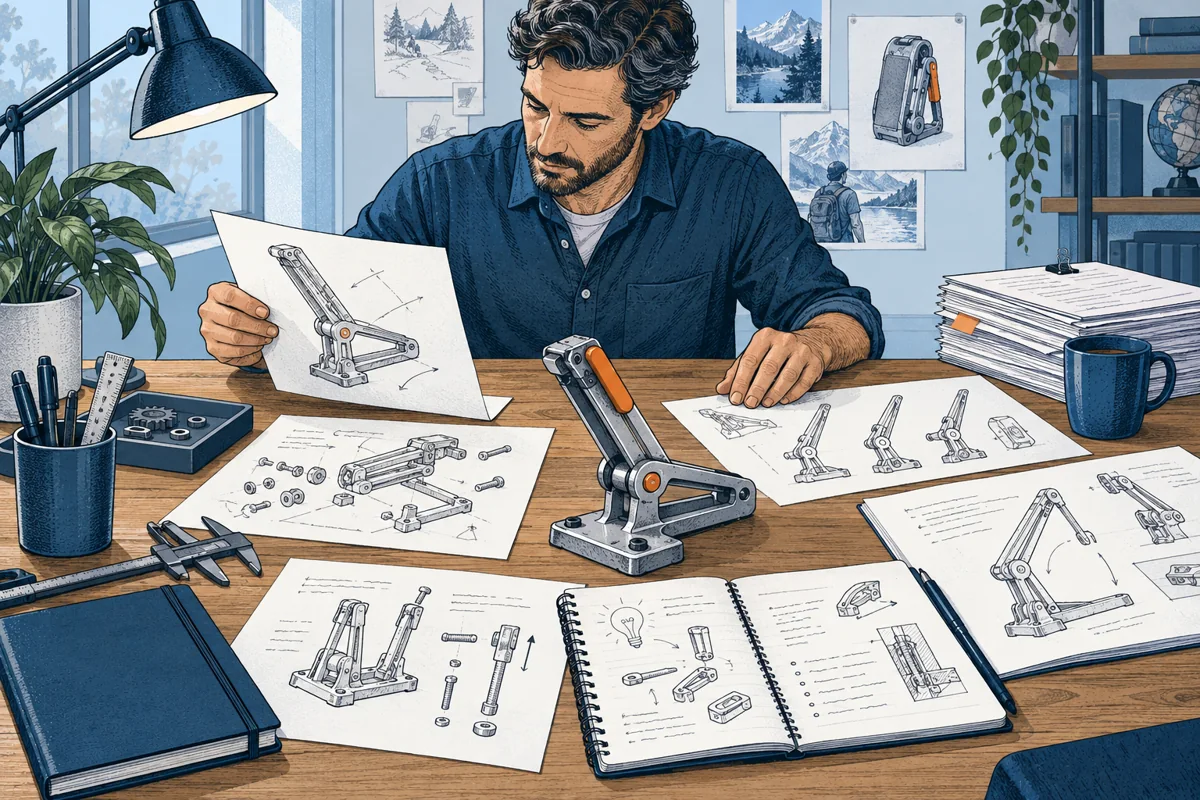
- Drawings. Use views that clarify hidden relationships and reference them in the text.
- Contribution record. Identify who contributed to the disclosed invention and preserve supporting development records.
Do not pad the packet with speculative variations that you cannot explain. Breadth is not achieved by adding a list of every possible material or technology. The disclosure should make the invention understandable, while legal advice determines how to describe and protect it effectively.
A hypothetical clamp disclosure
Suppose your invention is a clamp that opens one-handed and maintains a selected pressure. A marketing paragraph says it is “fast, safe and easy.” A technical packet explains the jaw arrangement, how the user moves the lever, how the retaining feature engages, and how the device releases. Drawings show both engaged and released states.
If a spring's position is essential, explain it. If two alternative retaining mechanisms have actually been developed, describe each clearly. If the device only works within a limited geometry, identify that limitation instead of implying universal performance. A failed bench test may reveal a necessary relationship that belongs in the discussion with the practitioner.
Now suppose you invent a substantially different release system three months after filing. Do not assume the original filing date automatically covers it. Record the new development and obtain advice about additional filings and disclosure before showing that version publicly.
Use a completeness review
Ask a technically competent reader, under suitable confidentiality arrangements, to identify unexplained steps. Where would they have to invent their own solution to reproduce the described operation? Their questions can expose missing detail, although their review does not establish legal sufficiency.
Check terminology across text and drawings. If “retaining arm” and “release arm” refer to the same component, make that clear. Label versions and dates so a practitioner does not accidentally draft from an obsolete sketch. Keep actual test results distinct from predictions.
Plan the year after filing before filing
Create a calendar for product learning, funding decisions and follow-on application preparation. Do not schedule the first serious review for the last week of the ordinary deadline. Ask the practitioner to confirm the actual deadlines and any international priorities for your circumstances. Exceptional restoration procedures are not a sensible project plan.
WIPO: File a PCT application addresses priority timing for a PCT filing. International strategy needs attention early, especially when public disclosure or multiple filings are involved. A U.S. provisional is not a worldwide patent, and a later international filing is not an automatic grant in every country.
Budget for the process, not only the first filing
Separate preparation, filing, later application work, examination responses and possible foreign-stage expenses. Use current quotations and official fees rather than an old online total. Ask what is included in professional services and what changes in the invention could require additional work.
If you cannot support the likely next stage, discuss alternatives before treating the provisional as inexpensive permanent protection. Filing may still have a strategic purpose, but that purpose should be explicit. Avoid a plan that depends entirely on finding a buyer during the final month.
Common failure signals
- The packet describes only benefits, not implementation.
- Critical drawings exist only in a supplier's account.
- Inventor contributions are unclear or disputed.
- The public demo includes improvements missing from the filing.
- No one owns the follow-on deadline.
- The budget covers only the initial submission.
The useful deliverable
Finish with a versioned disclosure packet, drawing index, known-reference list, contributor record, disclosure history and calendar. Give the practitioner the actual materials you intend to show to others. This lets technical support, filing timing and business learning be considered together.
This is educational U.S. guidance, not legal advice. A provisional filing does not establish patentability, enforceable patent rights or freedom to operate, and the adequacy of a particular disclosure requires individualized review.