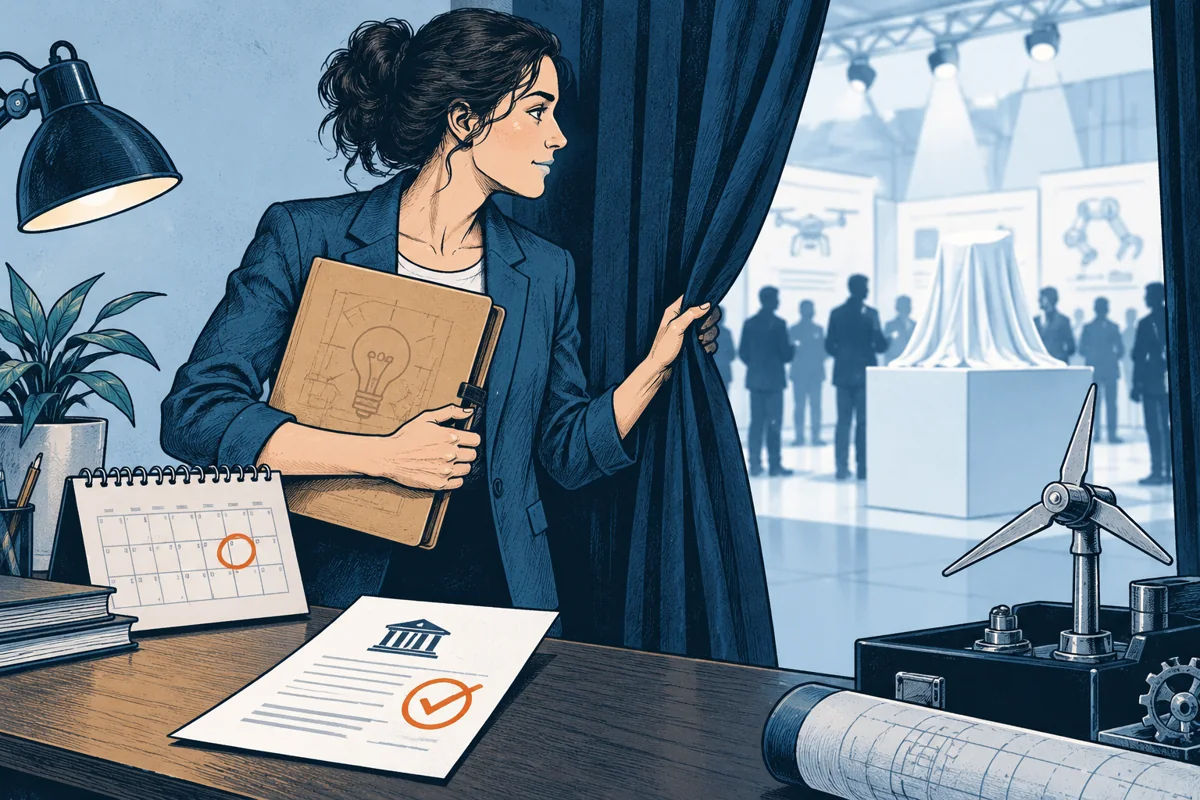
Start with the next event, not a generic deadline
The practical question is often “Can I show this at Saturday's event?” rather than “How long do inventors have to file?” Answering responsibly requires knowing what will be shown, who can access it, whether confidentiality exists, what has already happened, and where protection may be sought.
USPTO: Provisional application for patent warns that prefiling disclosure can affect foreign patenting even where a U.S. grace-period provision may apply. WIPO: Patent frequently asked questions explains that patent systems are territorial. The prudent planning approach is to review before exposure, not to assume every inventor has the same countdown.
Create a disclosure timeline
- List past events. Include presentations, websites, videos, samples, offers, sales discussions, competitions and shared technical files.
- Preserve exact content. Save slides, photographs, messages and the version of the product involved.
- Identify the audience. Record who had access and any relevant agreement or restriction.
- Record dates accurately. Distinguish creation, sending, public posting and actual availability.
- List future events. Add deadlines for demos, supplier reviews, crowdfunding and publication.
- Identify target countries. A strategy limited to one market differs from a multinational plan.
Do not delete an old post and assume the issue disappears. Preserve evidence for advice, while avoiding further unnecessary exposure. If a date is uncertain, label it uncertain and investigate rather than substituting a convenient estimate.
A hypothetical trade-show decision
An inventor plans to demonstrate a new dispensing mechanism at a local industry show. A prototype was already shown to a supplier two months earlier, and a short video was posted to a public account. The inventor remembers the video as “just a teaser,” but it reveals the moving parts clearly.
The next step is to gather the actual video, supplier correspondence and proposed show materials. A practitioner needs those facts to assess the situation. Filing an incomplete application the night before the show is not automatically a sound solution; the disclosure must support the invention that will be shown.
If the inventor cannot obtain appropriate review in time, changing the presentation to a carefully reviewed nontechnical discussion or postponing the reveal may preserve options. Whether a particular revised presentation is suitable still depends on its content. “No internal drawings” is not a universal safe harbor.
Separate filing readiness from presentation readiness
A technical concept may be developed enough to explain in a filing while not ready for a performance claim. Conversely, a polished prototype may contain important details missing from the application draft. Compare the proposed public material with the technical disclosure version by version.
Ask what changed since the last filing: mechanism, material, arrangement, software behavior or manufacturing process. Do not assume the phrase “patent pending” covers every future modification. Maintain a change log and ask which developments require further action.
Questions for the practitioner
- Which past events need closer analysis, and what evidence is missing?
- What jurisdictions and filing routes fit the business plan?
- Does the current disclosure support the version scheduled for release?
- What deadlines apply to this specific history?
- What information can be shared during ongoing customer or supplier research?
- Who will monitor the next filing and review dates?
Send these questions with actual documents rather than a verbal summary. The phrase “I told a few people” can cover very different circumstances, from a restricted technical meeting to an unrestricted pitch competition.
Common assumptions that create trouble
One is that a small audience is automatically private. Another is that removing a post restores the previous position. A third is that U.S. rules apply everywhere. A fourth is that any provisional filing, however thin, settles all later disclosure questions. Each assumption skips facts that can change the analysis.
Do not use a business article to calculate a last possible filing date after a disclosure. The consequences can be difficult to reverse, and exceptions can be technical. Seek advice promptly with the complete timeline rather than waiting until a remembered anniversary approaches.
Keep learning while the legal question is reviewed
You can often continue studying customer problems, current alternatives and purchase processes without revealing technical details. Prepare a neutral interview script and an approved information boundary. This keeps commercial research moving while the filing strategy is assessed.
Likewise, organize your drawings, test records and contributor information. Those are useful tasks regardless of the final filing decision. The outcome should be a coordinated calendar showing what may be released, which version is covered by the review, and what action precedes the next event.
This article provides educational planning guidance, not legal advice. It does not decide whether any event constitutes a legally significant disclosure or whether rights remain available in a particular jurisdiction.