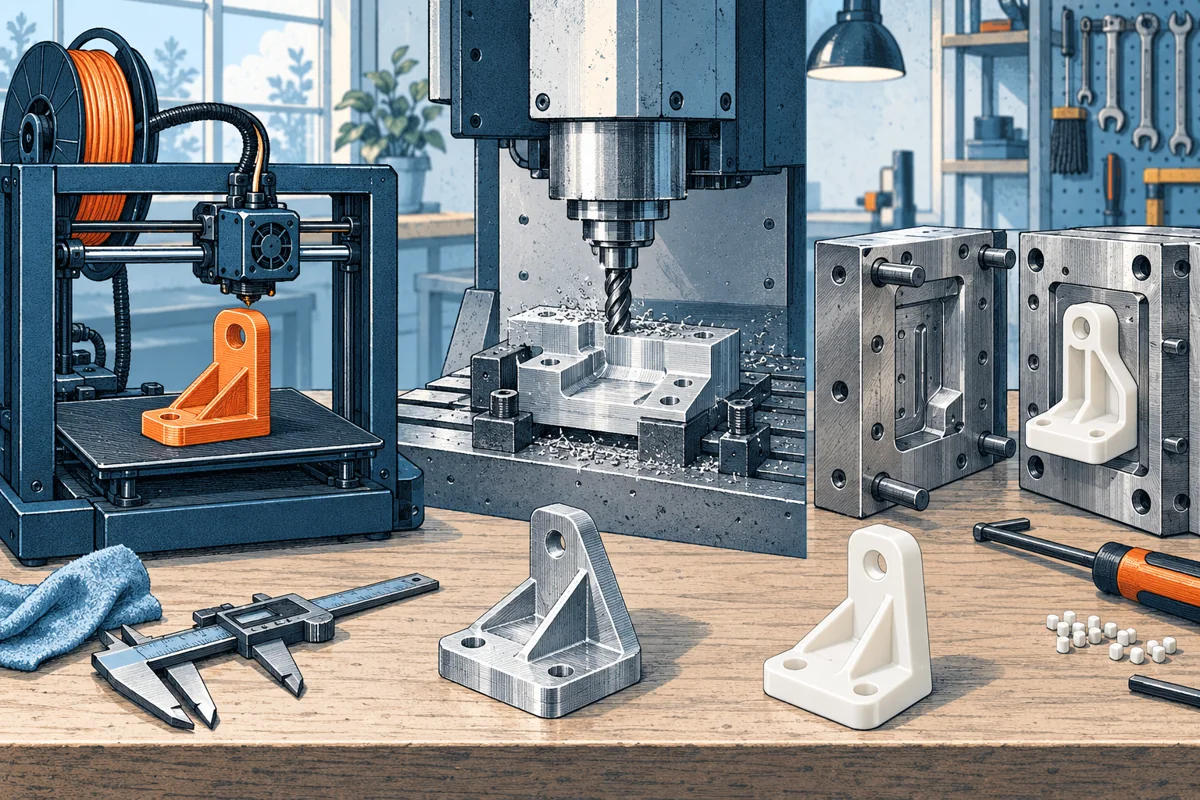
Start with constraints before comparing unit prices
The same nominal shape may not be equally feasible in three processes. A deep narrow pocket can complicate machining. A trapped cavity can complicate printing and cleaning. An undercut can complicate molding. Ask each supplier to review the actual geometry rather than relying on a general process comparison chart.
Material behavior may decide the issue. If the experiment concerns a production polymer's flexing behavior, a convenient visual resin may not be representative. If it concerns an envelope or control position, a fast printed model may be entirely appropriate. Match the process to the evidence required.
Protolabs publishes different design guidelines for milling and molding. Those pages illustrate why process selection is a design decision: the constraints are specific to geometry, material, and supplier capability. Treat their published values as that supplier's guidance, not universal limits for all manufacturing equipment.
Compare setup, repetition, and change costs
A quote should separate one-time work from recurring part cost. Tooling, programming, fixtures, finishing setup, inspection, and assembly can change the apparent economics. Shipping and rejected parts also affect the cost of usable units.
Design stability matters. A low molded unit price may be attractive, but a likely design change can require tool modification or a new tool. Printing or machining may carry a higher unit price while preserving flexibility. That flexibility has value when critical interfaces are still unresolved.
Ask about the quantity actually needed for the next decision, not only the optimistic lifetime forecast. A first batch for controlled evaluation may be much smaller than the quantity required after demand and design are established. Buying production economics prematurely can turn uncertainty into inventory.
A hypothetical enclosure cost comparison
Suppose a simple enclosure can be printed for an illustrative $28 per unit, machined for $65 per unit, or molded with a $6,000 tool and $4 recurring unit cost. These are invented arithmetic inputs, not current quotes. Ignoring other costs, molding equals printing at 6,000 divided by 28 minus 4, or 250 units.
That calculation is only a starting point. If the molded design requires another $1,500 of engineering and inspection setup, the crossing point changes. If half the first batch becomes obsolete after a design revision, nominal unit savings become less meaningful. If printing requires extensive hand finishing, its true recurring cost rises.
Now assume the inventor needs only twenty samples to test assembly and user access. Printing may be economically sensible even if the eventual product will be molded. If the next question is molded snap performance, however, those printed samples may not supply the needed evidence. The best process depends on the decision, not simply the lowest initial invoice.
Use a comparison table that includes the question answered, representative material behavior, lead time, change cost, inspection, and usable quantity. A process that cannot answer the critical question should not win merely through price.
Plan for the process transition
If molding is a likely later route, review draft, wall transitions, parting approach, and undercuts while the geometry is still flexible. Do not assume a printed shape can be sent unchanged to a mold maker. Likewise, a machined prototype may include features or material conditions that differ from the eventual process.
Identify evidence that must be repeated after transition. Fit may change through process variation, surface finish may affect sliding, and material behavior may affect retention. Keep the original results but state their limited transferability.
Consider a hybrid prototype when it serves the question: a machined reference interface with a printed noncritical body, for example. Document the hybrid's limits. It can reduce cost while preserving important behavior, but it should not be represented as proof of a single-process production design.
The process-selection record
Record geometry constraints, exact material candidates, critical features, quantities, design maturity, supplier assumptions, and total costs. Request manufacturability feedback and identify changes each process requires. Use the same functional requirements across quotes so the comparison remains meaningful.
Before selecting a process, confirm the inspection and handoff deliverables. A lower quote that omits required measurement evidence may not be comparable. Ask how the supplier handles revisions and whether the proposed route supports later repeat orders.
The deliverable is a process choice for a defined stage, with a reason and a transition plan. You do not have to choose the final lifetime process before learning from the next prototype, but you should understand what the temporary choice can and cannot prove.