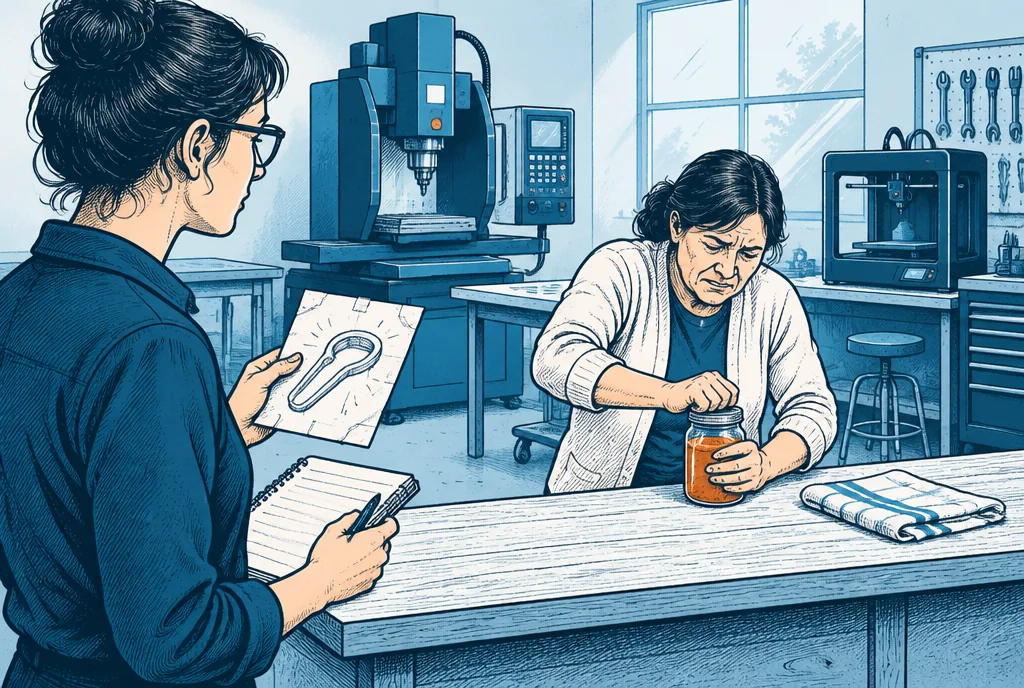
Choose the decision the research must support
Before ordering parts, write the next spending decision in plain language: “Should I spend $1,500 developing a bench model for independent bicycle mechanics?” A bounded decision is easier to investigate than “Is my invention good?” It also prevents a successful interview from becoming permission for an unrelated expense, such as production tooling.
Create three separate columns: customer problem, technical feasibility, and commercial viability. People can have a serious problem that your mechanism cannot solve affordably. A mechanism can work beautifully for a problem that rarely matters. Keep these questions separate throughout the research. The SBA: Market research and competitive analysis identifies demand and competition as market-research concerns; the worksheet here is a proposed way to investigate them.
Collect evidence of actual episodes
- Specify the situation. Replace “cyclists need better tools” with “mobile mechanics must support a bicycle on uneven ground while adjusting its drivetrain.” The narrower statement tells you whom to find and what event to discuss.
- Ask about the last occurrence. Learn when it happened, what the person tried, how long it took, and what happened if they did nothing. Ask to see the current tool or setup when practical.
- Record the workaround. A improvised stand, borrowed equipment or refused job provides a baseline. Record both its shortcomings and the reasons the mechanic continues using it.
- Identify the buying path. The person struggling may not purchase tools. Ask who approved the most recent equipment purchase and what it replaced.
- Request a relevant next action. Invite qualified participants to a later fit test or ask permission to observe the task. A specific scheduled action is more informative than general encouragement.
These interviews should first explore work, not sell your solution. NASA: I-Corps describes customer discovery as testing business hypotheses through customer conversations. Your own research does not need to imitate a grant program's interview count; it needs enough contrasting observations to expose mistaken assumptions.
A hypothetical mechanic example
Imagine interviewing eight mobile mechanics. Five say unstable supports are annoying. That sounds promising until the episode records show that three encounter the issue only twice a year and already borrow a stand. Two mechanics work at outdoor races every weekend and lose setup time repeatedly. The other three interviewees work primarily indoors and never experience the proposed problem.
The finding is not “five of eight people want the invention.” It is that event mechanics may be a useful initial segment. Arrange a second research round around that workflow. Compare loading, carrying, deployment, adjustment and pack-down time. A stand that saves five minutes during adjustment but adds ten minutes of unloading may reduce overall value.
Suppose one event mechanic allows observation and demonstrates six setup cycles during a morning. Another supplies a list of space and weight restrictions. Those are practical commitments to learning, not orders. They justify a low-cost size mockup if carrying dimensions remain uncertain; they do not justify manufacturing fifty units.
Write the test before seeing the results
Use a short test card with an assumption, participant definition, method, evidence to collect, and a spending limit. For example, the assumption might be that event mechanics repeatedly lose setup time and can carry a device under a stated size. The method could combine interviews with a cardboard packaging mockup. Your success criterion should describe evidence of the problem and fit, not an arbitrary approval percentage.
Set a decision date and say what each result would mean. Repeated, consequential episodes plus a feasible carrying envelope may support a functional prototype. Repeated episodes with impossible transport requirements may call for a different mechanism. No recent episodes may call for a new customer group or a stop. These are project-specific rules, not statistically validated thresholds.
Diagnose misleading positive feedback
- Everyone likes the idea. You may be presenting it too early. Repeat the conversation without the drawing and ask about existing behavior.
- People report pain but refuse a follow-up. Check urgency, scheduling burden and whether you contacted the real user. Refusal has several possible explanations.
- Friends give detailed suggestions. Suggestions reveal imagination, not necessarily purchasing intent. Recruit outside your personal circle.
- One participant demands many features. Investigate whether those needs recur. A custom project can masquerade as a broad product opportunity.
The deliverable: a one-page evidence brief
Include the segment, observed problem episodes, current alternatives, consequences, buyer, strongest contradictory observation, and next experiment. Attach anonymized notes so a skeptical reader can trace each conclusion. Label assumptions and estimates explicitly. Keep raw contact details separate from the shared brief and get permission before recording conversations.
Close with the exact expenditure supported by the evidence. “Build a weighted cardboard mockup to check transport fit” is a stronger conclusion than “Proceed with invention.” Early qualitative research cannot estimate national demand or establish patent rights. Its useful output is a narrower, better-supported question and a cheaper way to answer it.