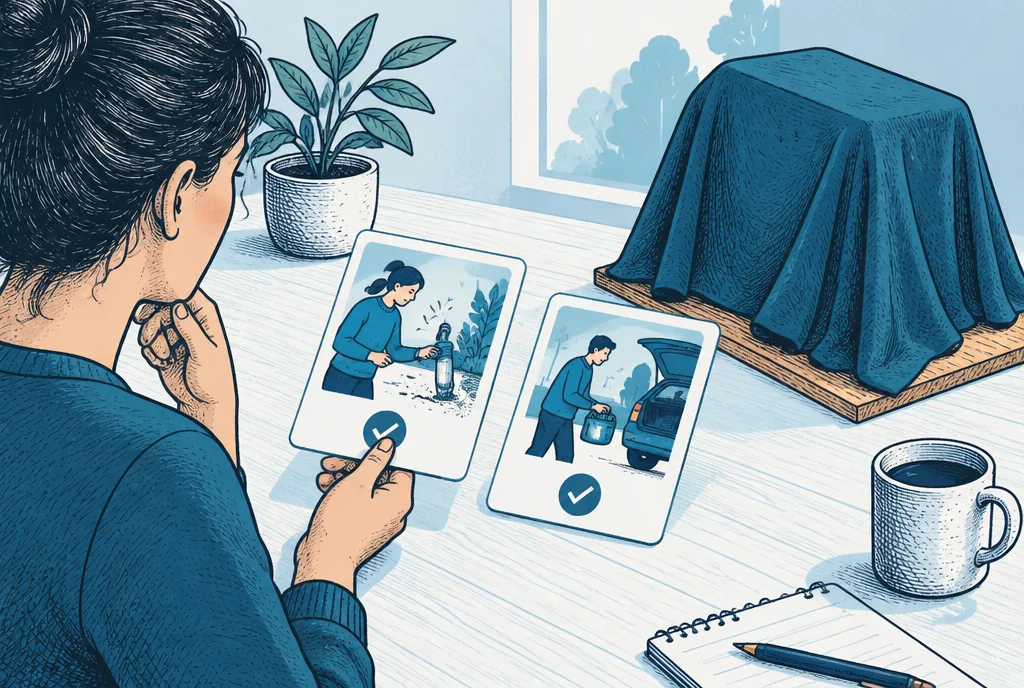
Separate three different questions
You can investigate whether people struggle to open packaging without explaining a novel cutting mechanism. You can learn whether they will carry an additional tool without revealing its internal linkage. You cannot establish that the linkage works merely by collecting positive reactions to an outcome description. Demand, usability and technical performance need different evidence.
Use three information levels: problem discussion, outcome demonstration and technical explanation. Decide which level each research question actually requires. This makes disclosure a deliberate choice rather than a byproduct of an enthusiastic conversation.
Create a research brief with a disclosure boundary
- Name the participant. Choose people who perform the relevant task, such as adults who regularly open bulk shipping cartons.
- Describe the outcome neutrally. “We are researching ways to open cartons with less handling” is less revealing than a diagram of the mechanism, but still must be assessed in context.
- List what can be shown. Approved photographs, a sealed exterior mockup and a task description belong on a release list.
- List what stays private. Internal geometry, material formulation, control settings and source files may require separate handling.
- Plan a stopping sentence. “That part is still under development; today we are evaluating the task and the exterior form” prevents improvised technical explanations.
The distinction is operational, not a legal safe harbor. WIPO: How to protect trade secrets discusses reasonable confidentiality measures. A closed housing can still reveal dimensions, behavior or interfaces that matter to an invention, so have sensitive demonstrations reviewed before using them publicly.
Choose a test that matches the uncertainty
For a problem test, ask about recent episodes and existing workarounds. For an outcome test, describe a realistic benefit alongside limitations and an expected use context. For a form test, use a nonfunctional model to evaluate carrying, grip and storage. Clearly tell participants which aspects are simulated. Never let a polished rendering imply that performance has been demonstrated.
A landing page can test response to a proposition, but it also creates public material. Avoid publishing a technical explanation merely to improve conversion. Label prototypes and availability accurately, collect only necessary contact information, and separate an invitation to research from an order. Do not accept payments until you are ready to meet the resulting obligations.
A hypothetical packaging-tool study
Suppose an inventor has a concealed mechanism intended to reduce carton-opening effort. In round one, six stockroom workers describe their last unpacking shift. Four say blade replacement is the real nuisance; two say wrist posture is the problem. No mechanism has been disclosed, and the inventor already has information that could change the design.
In round two, participants handle a solid exterior mockup. It contains no working mechanism and is labeled nonfunctional. The inventor records whether it fits standard storage pockets and whether workers can grasp it with gloves. Three find it too bulky. That result supports resizing the enclosure, not a claim about cutting effectiveness.
A third round needs a functional comparison. The inventor now prepares a controlled test plan, confirms appropriate confidentiality arrangements where needed, and reviews filing timing with a patent practitioner. The delayed technical disclosure has bought useful learning, but the earlier conversations did not themselves establish legal protection.
Recognize when secrecy damages the research
If participants cannot understand the tradeoff, their answers are not meaningful. “Would you buy a tool that does everything better?” is not a useful test. State relevant burdens: size, cleaning, training, consumables and an estimated price range. You can often disclose those without revealing the inventive details, but sometimes the mechanism and the commercial proposition are inseparable.
In that case, use a smaller controlled study or make a filing decision before wider research. An NDA is not always available or suitable, and a counterparty may refuse one for legitimate reasons. Refusal does not prove bad intent; it changes which information you should share and whether the research can proceed.
Keep an exposure record
- Save the exact version of each presentation and mockup shown.
- Record date, audience, purpose and any agreement covering the exchange.
- Note unexpected questions and any unplanned disclosures.
- Keep public pages, screenshots and social posts in the record, including removed versions.
- Ask a patent practitioner to assess uncertainty before relying on a filing deadline.
USPTO: Provisional application for patent explains that U.S. disclosure rules and foreign patent consequences differ. This guide deliberately does not supply a universal countdown from a demonstration. What was disclosed, by whom, under what circumstances and where protection is sought can all matter.
The useful output
Finish with two documents: an evidence brief describing the customer need, and a disclosure log describing what you exposed. Keeping them separate helps you learn commercially without losing track of the IP question. Your next step may be another problem interview, a revised enclosure, or professional advice before a functional demonstration.
This is educational planning guidance, not legal advice. Outcome-only research can reduce unnecessary disclosure, but it cannot guarantee patentability, trade-secret protection or freedom to operate.