Find the missing condition inside a vague adjective
Words such as strong, compact, intuitive, and reliable express intentions but do not tell a designer what to build or a tester what to observe. Ask what failure prompted the adjective. “Strong” may mean not bending during normal handling, surviving an accidental drop, or retaining a clamp force over time. These are different requirements and may favor different designs.
Start from a specific user situation. Identify the object handled, the environment, the sequence, and the consequence of failure. A storage clip that holds a paper note has a different risk profile from a device supporting a person. Requirements and test rigor should reflect those differences rather than adopting dramatic load numbers from unrelated products.
NASA's system-design material describes transforming expectations into technical requirements. For an inventor, the practical move is to write one observable behavior at a time. A sentence combining appearance, durability, price, and ease of use should be split so that each concern can be evaluated and revised independently.
Use a requirement record with four essential fields
Give the requirement an identifier and a plain-language statement. Add the operating conditions and acceptance rule. Then specify the proposed evidence: inspection, measurement, analysis, demonstration, or a structured user task. A requirement that lacks a plausible verification method often contains an unresolved assumption.
For example, “The lid shall remain attached during the defined carrying task with the specified reference contents” is more useful than “The lid shall be secure.” You still need to define the carrying task and contents. Keep those in a referenced test description rather than making the sentence unreadably long. Mark provisional thresholds clearly and identify who will resolve them.
Avoid specifying a solution unless it is genuinely constrained. “The product shall use a steel spring” may prematurely exclude a simpler mechanism. “The release shall return to its closed position after the user removes pressure” states the needed behavior. A particular material may later become necessary, but it should have a reason that survives a design review.
A hypothetical portable parts tray
Suppose the invention is a small tray for organizing craft components. The initial brief says “lightweight, sturdy, and easy to carry.” The inventor first identifies the actual scenario: an adult carries the tray between two tables, places it down, opens it, and retrieves one compartment's contents. That scenario yields several independent questions.
A dimensional requirement might limit the tray's footprint to a measured storage space. A carrying requirement might specify that the latch stays closed with a defined reference load during the chosen handling sequence. A usability requirement might require participants to identify the opening control without a spoken hint after reading the proposed label. These are illustrative requirements, not product standards.
The first test finds that participants identify the control but open the tray in the wrong orientation. The requirement was too narrow: identifying the control did not establish successful opening. Revise the task outcome to include keeping the reference contents in their intended compartments. Preserve the original result and the reason for the requirement change.
This is why requirements need validation as well as verification. A team can accurately test the wrong question. Observing actual task completion helps reveal a requirement set that misses important parts of the intended use.
Choose thresholds with evidence and acknowledge uncertainty
Thresholds may come from measured interfaces, user needs, established engineering analysis, applicable standards, or a comparison with an existing solution. Record that origin. A number chosen merely because it looks precise can make the project expensive without improving usefulness.
When you do not yet know the acceptable operating force, make the first experiment a characterization study. Measure or compare candidate forces under a defined task, collect observations, and use the results to propose a threshold. Do not pretend the exploratory experiment was a pass/fail qualification against a requirement that did not exist until afterward.
Include measurement limits in the acceptance plan. If the distinction between pass and fail is smaller than the uncertainty of the available method, improve the method or revisit the requirement. More decimal places in a spreadsheet do not increase the quality of the measurement. Near-boundary decisions need an agreed rule rather than improvised rounding.
Maintain a small requirements-to-evidence checklist
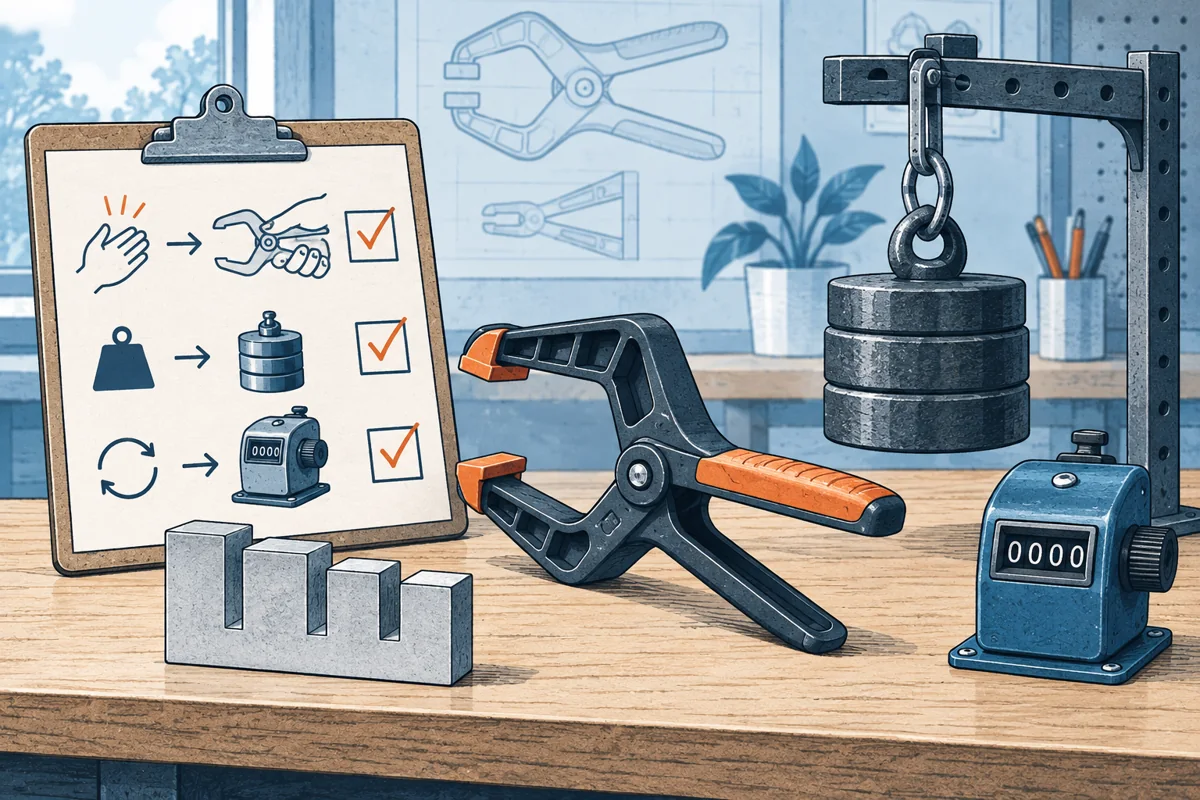
Use one row per requirement with columns for its source, current version, proposed method, result location, and open issue. Link photographs or raw measurements to the row. A green status should mean that the specified evidence exists for the identified configuration, not that someone feels confident about the design.
Review conflicts before fabrication. A narrower enclosure may reduce available finger space. A stiffer latch may improve retention while making opening harder. State the tradeoff and decide which requirement has priority or whether the design needs another approach. Hiding the conflict creates repeated redesign later.
A completed prototype checklist should reveal both passed requirements and untested assumptions. That makes it useful for the next designer and prevents an attractive demonstration from becoming a substitute for a documented account of what the prototype actually accomplished.