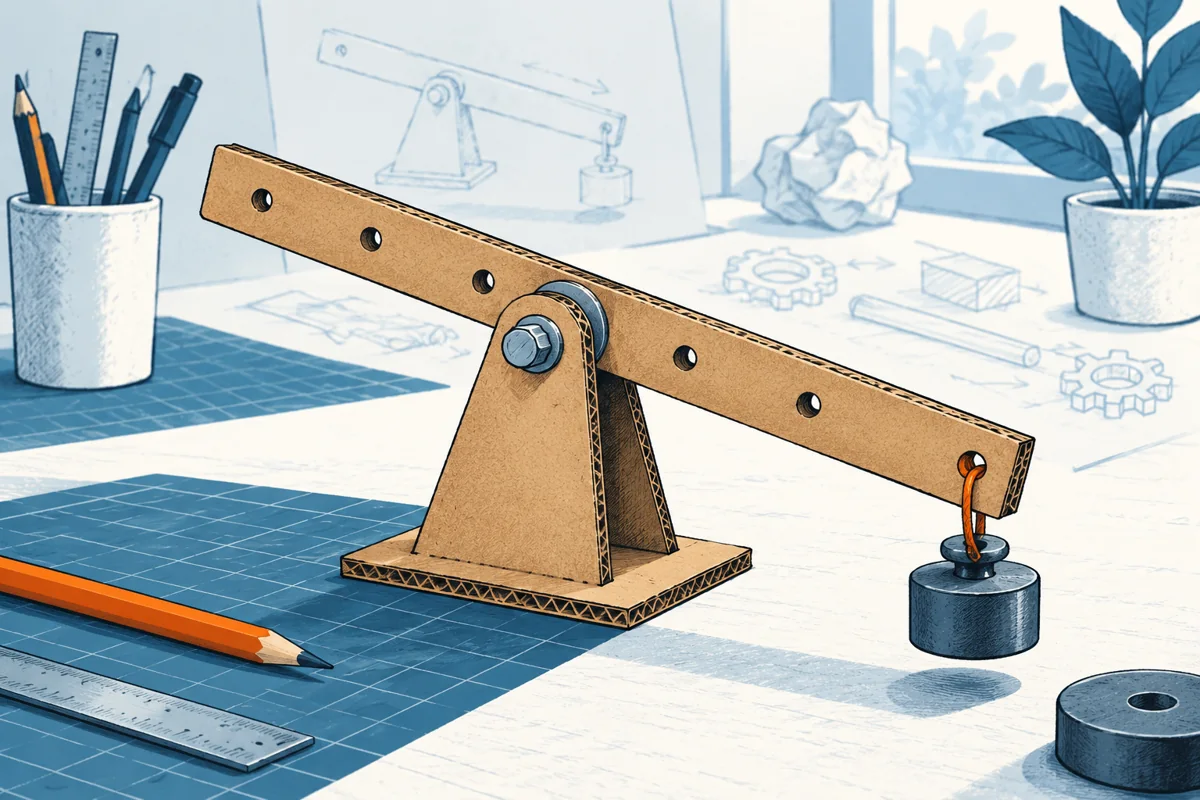
Start with a decision, not a miniature finished product
An independent inventor often asks a fabricator to make the entire invention before deciding what needs to be learned. That creates an expensive object with several possible explanations for success or failure. If the handle feels uncomfortable, the mechanism binds, and the enclosure breaks, the next design change becomes guesswork. Separate those uncertainties before combining them.
Write a decision sentence: “If a one-handed user cannot release the latch without moving the base, we will change the release arrangement before designing the enclosure.” This identifies a behavior, an observation, and a consequence. “See whether people like it” does none of those things. Your first experiment does not need to establish every product requirement; it needs to make the next investment less speculative.
NASA's design process separates expectations, requirements, and design solutions. An inventor can adopt that distinction without adopting a space-program paperwork system. Keep one page containing the intended user, the task, the most consequential unknown, and the evidence needed to resolve it. The physical object follows from that page.
Choose a representation that preserves the relevant behavior
A cardboard volume can answer whether a storage accessory obstructs a drawer. It cannot establish hinge durability. A simple rig using a purchased hinge can compare access directions, but it does not prove that a later custom plastic hinge will survive repeated use. A polished appearance model may be appropriate for a conversation about styling, provided participants are told which interactions are simulated.
Preserve the variables that could change the answer. For a grip study, include realistic handle diameter, reach, orientation, and approximate mass distribution. Surface finish may matter if slipping is the question. For a fit study, reproduce the actual mating object, not an idealized photograph. For a load-path question, a soft visual model is insufficient even if its dimensions are accurate.
Make a short equivalence statement for every substitute: “The temporary base has the intended footprint but is heavier, so this study can assess reach but may overstate stability.” This protects you from transferring conclusions to a design that was never tested. It also helps a hired designer choose useful shortcuts instead of spending your money reproducing irrelevant details.
A hypothetical drawer-organizer experiment
Suppose an inventor wants a divider that expands with one hand. The uncertain feature is the adjustment gesture, not the eventual plastic grade. There are three candidate interactions: sliding a lever, squeezing two tabs, and turning a knob. Building three complete molded-looking products would consume money before the interaction is selected.
Instead, construct three low-energy interaction mockups using the same drawer, divider length, and approximate resistance. Define success as adjusting to three marked widths without lifting the assembly or asking for an explanation after a standard introduction. Record completion, corrections, accidental release, and comments separately. The marks and timing are illustrative study choices, not universal usability thresholds.
Imagine the lever version is fastest but repeatedly releases when users touch the divider. The squeeze version takes longer yet avoids accidental release. The result does not automatically select the squeeze version. It identifies a tradeoff: can the lever be guarded without making access awkward? A small fourth mockup may resolve that question more efficiently than polishing the current favorite.
The deliverable is a comparison sheet with photographs, configuration IDs, observations, and a decision. It is not a claim that the product is production-ready. Neither the drawer study nor positive participant comments establish material life, shipment survival, or broad market demand.
Give a builder a brief that discourages unnecessary work
State the experiment's purpose and which features must be representative. Mark cosmetic surfaces, hidden supports, and temporary fasteners that can remain crude. Request separate pricing for the test rig and any optional appearance work. Require editable design files where applicable, a parts list, and a description of substitutions so the prototype can be reproduced or modified.
Agree on the handoff evidence. For a motion prototype, a short video should show the starting state, full operation, and return to the starting state without cuts concealing resets. Include failed attempts rather than retaining only the best demonstration. Ask the builder to identify adjustments made between attempts; a mechanism that needs constant tuning is a different result from a repeatable mechanism.
Before authorizing the build, check that the outcome can distinguish the options. If every result would lead you to continue unchanged, the test is probably a demonstration rather than a decision experiment. Demonstrations have a role, but label the expenditure honestly.
Close the first experiment before adding features
Record the question, prototype version, conditions, observations, decision, and remaining uncertainty. Archive the abandoned option as well as the selected one. Otherwise a later collaborator may revive the same weak concept without knowing why it was rejected.
Your completion checklist is short: the relevant behavior was represented; the acceptance rule existed before the test; unexpected results were retained; substitutions were disclosed; and one next action follows from the evidence. If the experiment exposed a new critical unknown, plan a separate test rather than silently extending the meaning of the old result.
A successful first prototype can be an unattractive rig that prevents an expensive mistake. The money saved comes from stopping unsupported assumptions before they become detailed drawings, supplier commitments, and tooling.