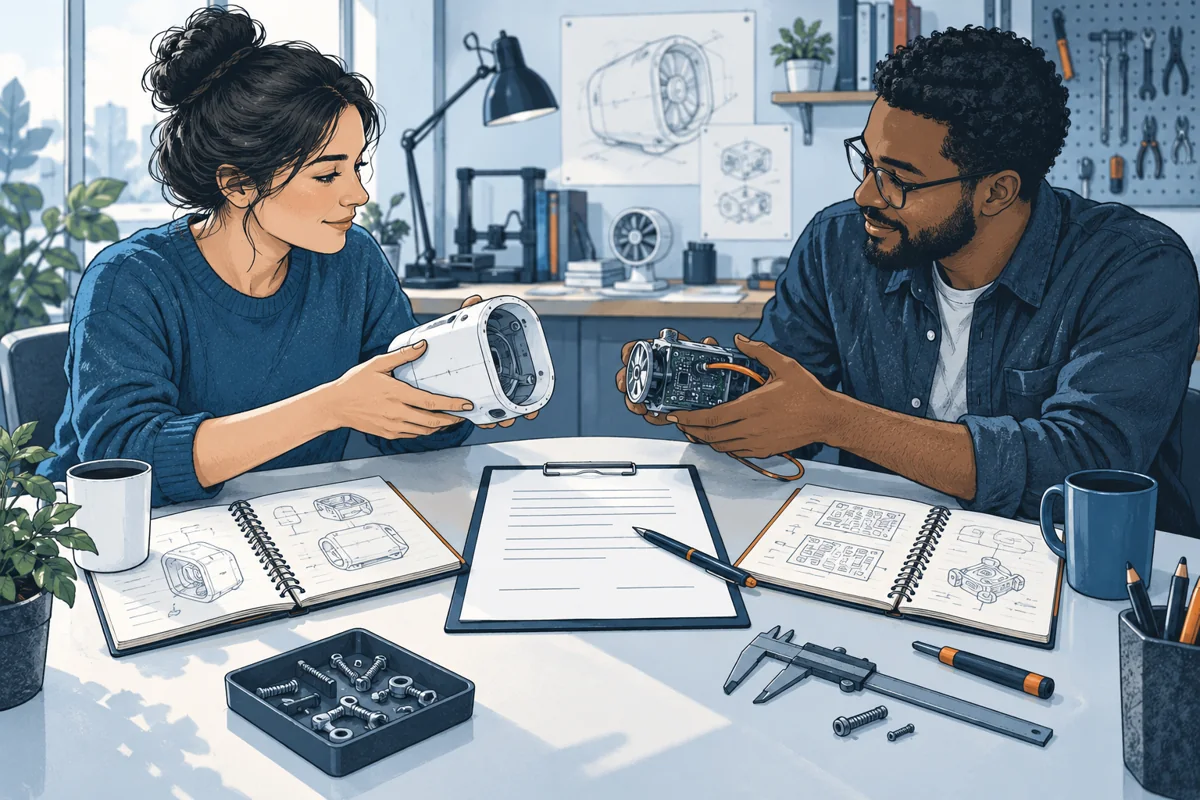
Discuss the difficult scenarios while agreement is easy
Two people can agree enthusiastically about a product and still mean different things by “we own it together.” One may expect equal control, another may expect the company to own all rights, and a third collaborator may assume payment includes a share. Write down the intended arrangement before technical and financial contributions become tangled.
USPTO: Managing a patent describes important U.S. consequences of joint patent ownership in the absence of a contrary agreement. USPTO: MPEP 2109.01, Joint inventorship addresses inventorship separately. Those sources are a reason to obtain tailored advice, not a template for a partnership arrangement.
Inventory what each person brings
- Pre-existing inventions. Identify prior designs, prototypes, applications and know-how.
- Other obligations. Disclose relevant employer, university, client or funding commitments to counsel.
- Expected work. Describe engineering, research, sales, administration and manufacturing responsibilities.
- Money and assets. Record cash, equipment, materials and reimbursable expenses.
- Future outputs. Define how new project rights are intended to be held and documented.
- Decision authority. Identify who can approve filings, disclosures, licenses and major spending.
Do not substitute an equity percentage for every item. Equity can compensate business contributions, while legal inventorship depends on the relevant technical facts. A rights assignment and a company ownership agreement may serve different functions.
A hypothetical two-founder disagreement
Alex contributes an early mechanism and Sam develops the control system. They agree verbally to split the business equally. After six months, Sam wants to license the technology to an established manufacturer, while Alex wants to manufacture directly. Neither has agreed who can authorize a license or how patent expenses are funded.
The disagreement is not solved by asking who worked more hours. They need a governance and rights framework addressing the decision. If they had discussed the licensing scenario at the start, they could have chosen approval rules and a process for deadlock before the opportunity arrived.
Now add a departure: Sam accepts another job. The project still needs source files, technical support and signatures for appropriate patent work. Those practical dependencies should be addressed in the agreement and handoff process rather than left to goodwill alone.
Decisions that deserve explicit treatment
| Decision | Question to resolve |
|---|---|
| Public disclosure | Who approves presentations and releases? |
| Patent work | Who instructs counsel and funds each stage? |
| Licensing | Who can authorize terms and territories? |
| Transfer | Can a person sell or assign an interest? |
| Departure | What rights, files and duties remain? |
| Deadlock | What process resolves an impasse? |
Keep contribution records factual
Use development notes to record technical proposals, experiments and decisions. Do not turn every meeting into a negotiation over inventor status. A practitioner can assess the relevant contributions when the claims are developed. The record should make that assessment possible without depending on memories after a dispute.
Also document business decisions and expenditures separately. If one person pays a filing bill, record whether it is a contribution, loan or reimbursable expense under the agreed terms. Ambiguous accounting can become an ownership argument later.
Address company formation deliberately
If the plan is for a company to hold rights, ask counsel what documents and actions are needed. Merely creating an entity or using its logo does not necessarily move every pre-existing asset into it. Identify which assets are transferred, licensed or retained and what rights the company needs to operate.
For outside contractors, maintain a consistent rights chain into the intended owner. A clear founder arrangement can still be undermined by missing contractor terms or an unresolved employer obligation. Review the whole development team rather than only the founders.
Plan a workable departure process
Discuss access removal, delivery of files, ongoing confidentiality, cooperation with appropriate filings, compensation and use of retained knowledge. The legal terms need tailored advice, but the operational handoff can be described concretely: repositories, prototypes, supplier contacts and documentation.
A departure agreement should not depend on pretending that a person's historical contribution never happened. Separate recognition and legal inventorship from continuing ownership and business participation. Preserve records even when the relationship ends badly.
Warning signs before major spending
- Everyone uses “equal ownership” without defining the asset or entity.
- One founder can publish technical details without consultation.
- No one is responsible for filing deadlines.
- Existing IP is mixed with project IP without documentation.
- Departure and licensing questions are dismissed as pessimistic.
- Equity is promised in exchange for being named as an inventor.
The founder briefing packet
Prepare an asset inventory, role map, contribution record, decision list and departure scenarios. Use them with counsel to create the appropriate agreements. The goal is not to predict every disagreement; it is to establish a process that lets the project continue without inventing the rules during a crisis.
This is educational guidance, not legal advice. Joint rights, company governance and employment obligations vary by jurisdiction and agreement.