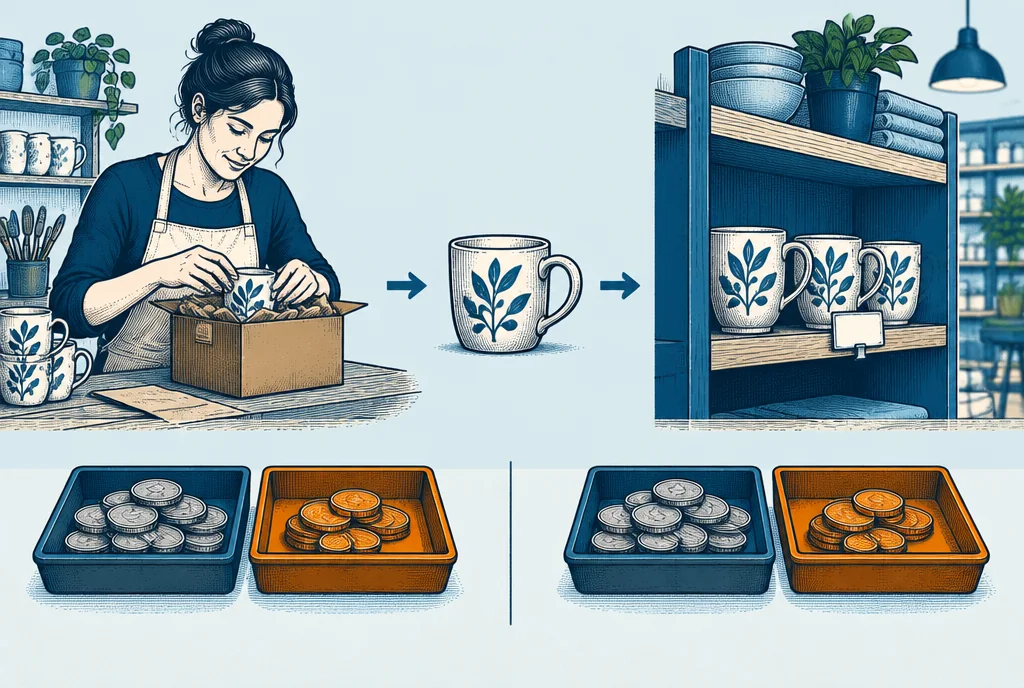
Start with the shelf and the transaction
Document comparable products, their function, package quantity, and visible selling price. A premium comparison is useful only if customers can understand why yours belongs beside it. Then ask the prospective retailer how it buys: outright purchase, consignment, distributor arrangement, or a trial with returns. Each produces different receipts and risk.
Do not treat retail price as inventor revenue. Ask which party pays shipping, who funds promotions, whether allowances apply, and when payment occurs. A retailer's desired margin is a negotiating input, not a universal law. The price model must reflect the actual account and order rather than an internet rule of thumb.
Calculate contribution with a concrete example
Assume a hypothetical $40 retail price and an agreed $20 wholesale price. Your landed product and package cost is $9. A $1 shipping allowance, $1 sales commission, and $0.60 expected returns cost leave $8.40 contribution per unit before fixed overhead and development recovery. That is 42% of wholesale revenue, not 42% of the shelf price.
A 10% wholesale promotion reduces receipts to $18. If the other costs stay unchanged, contribution falls to $6.40. The discount consumes $2 of contribution, or about 23.8% of the original $8.40. This is why a modest discount can have a much larger effect on earnings than its headline percentage suggests.
Compare direct sales fairly
Direct sales at $40 may look twice as attractive as $20 wholesale. Include payment processing, pick and pack, outbound delivery subsidy, customer acquisition, and individual customer support before drawing that conclusion. A retailer may deliver a large consolidated order; direct selling may require finding and fulfilling each buyer individually.
Use separate worksheets for the channels. Avoid charging the same costs twice or assuming that all direct customers arrive free. Check whether a direct discount undercuts the commercial proposition offered to retailers. That is a practical relationship issue requiring clear channel planning, even before any contract restrictions are considered.
Fix the right part of an unworkable offer
If contribution is too thin, identify whether product cost, channel deductions, packaging, or the intended shelf price is responsible. Consider a different pack size or feature set only if it still solves the customer problem. Selling an unsuitable product at a mathematically profitable price is not a workable business.
Request a small, clearly defined trial instead of granting broad concessions immediately. Record the trial quantity, net price, return terms, and evaluation date. After the trial, compare actual deductions and sell-through with the model. Reorders supported by real customer demand provide stronger negotiating evidence than a speculative promise of future volume.
Model order size and account-level costs
Some wholesale costs belong to the order or account rather than to each unit. A $60 freight charge on a 12-unit order adds $5 per unit; the same charge on 60 units adds $1. A price that works for a full case may fail for frequent small replenishments. Model the expected order pattern and state minimum quantities or freight treatment clearly in the proposed terms. Do not bury this issue in an average that assumes every buyer orders the largest quantity.
Account setup can also require samples, photography, data entry, special labels, or packaging changes. Estimate those costs before accepting a trial. Suppose setup costs $500 and each unit contributes $8.40 before setup recovery. Roughly 60 units are needed just to cover that account-specific expense. A 24-unit trial may still be worthwhile as an experiment, but it should be identified as an investment rather than presented as immediately profitable.
When reviewing a retailer's deductions, compare the remittance to the purchase order and agreed terms. Track allowances and short payments by reason. If the same charge appears repeatedly, update the model instead of treating every instance as an exception. Wholesale can be attractive because orders are consolidated, but its real value emerges from collected receipts and repeatable account economics, not the nominal price printed on a sales sheet.
Include a payment-lag row in the account model. If a hypothetical $1,080 order is delivered now but collected later, the production and freight cash must come from somewhere else during that interval. A profitable invoice is not immediately available funding. Compare the proposed terms with the timing of the next replenishment order. If the retailer wants larger volume, check whether the resulting cash gap grows faster than the collected contribution, and negotiate from that complete picture rather than the unit margin alone.
Decision checklist
- Have net receipts replaced shelf price in the wholesale calculation?
- Are promotion and return assumptions written down?
- Does direct-channel pricing include acquisition and fulfillment?
- Is the offer viable without assuming every trial turns into a large reorder?