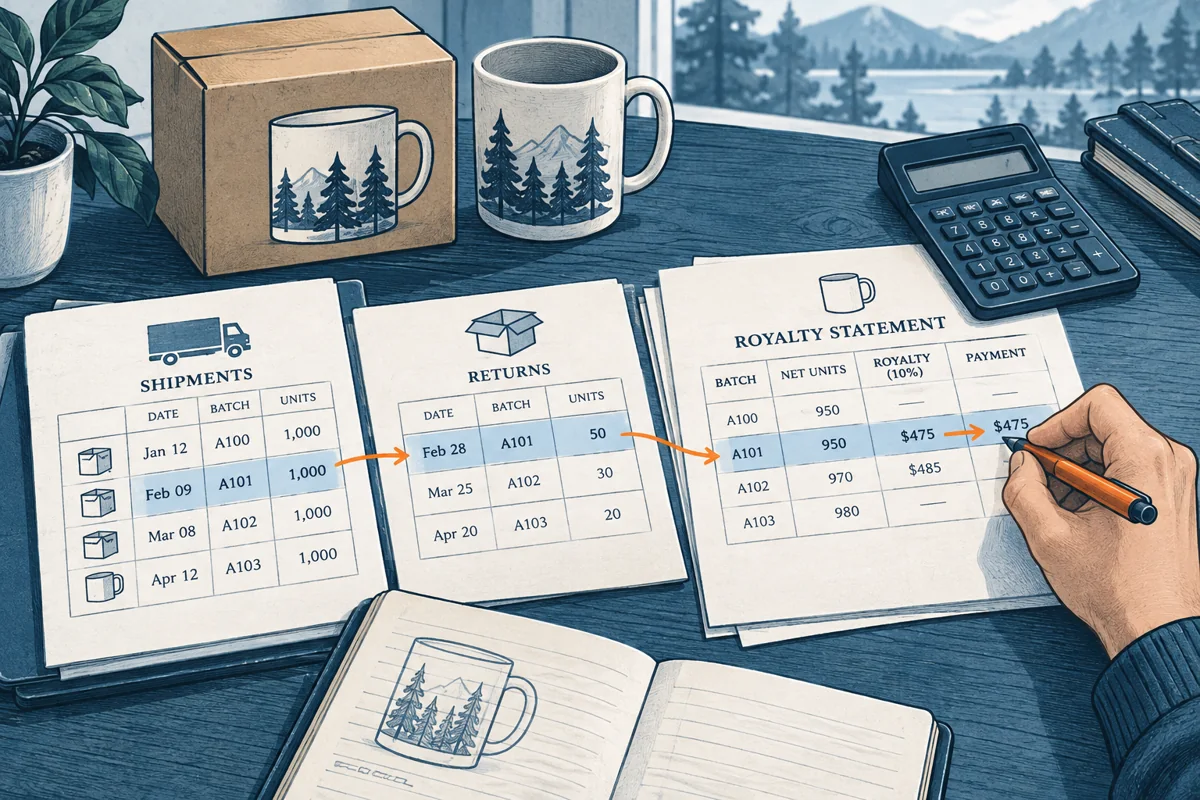
Translate the agreement into a worksheet
List reporting period, covered products, territories, qualifying sales definition, allowed deductions, rate, minimums, advances, and payment timing. Include effective dates when terms change. The calculation must follow the executed agreement, not an earlier proposal or what either party remembers discussing.
Keep the original statement intact and perform your analysis in a separate file. Record each assumption and missing field. If the statement lacks units or deduction detail necessary to reproduce it, request the information identified by the agreement. Do not fill gaps with favorable guesses and call the result an underpayment.
Recalculate a hypothetical period
Suppose a statement reports $100,000 qualifying gross sales, $5,000 permitted returns, and $3,000 permitted discounts. Under an illustrative agreement allowing only those deductions, the base is $92,000. At 4%, the royalty is $3,680 before any separately applicable contractual adjustments.
If the statement instead deducts another $7,000 marketing charge, the base becomes $85,000 and the payment $3,400, a $280 difference. The arithmetic identifies the disputed treatment, but the contract determines whether it is allowed. The example does not establish a universal deduction rule or recommended royalty rate.
Check timing and adjustments
A sale near the reporting boundary, a later return, foreign-currency conversion, or credit against an advance can explain differences between expected and paid amounts. Review the relevant definitions and prior statements. Do not count the same adjustment in two periods.
Compare the amount due with the actual payment date and bank receipt, accounting for documented transfer charges where applicable. Distinguish a late statement, a late payment, an unexplained deduction, and a missing product. Each calls for a different question. A general complaint that royalties seem low is less useful than a reconciliation showing the exact line and amount.
Escalate with a clear record
Send a concise question identifying the period, clause, calculation, and requested clarification. Keep correspondence and corrected statements together. If the issue is resolved, update the reconciliation without deleting the history. Recurring discrepancies may indicate a process problem even when individual amounts are small.
If information remains unavailable or a material dispute persists, review notice, record-access, audit, and dispute provisions with counsel. Deadlines and costs may matter. Do not threaten action based on unverified assumptions or attempt to obtain confidential records outside your rights. The practical objective is a reproducible accounting and a proportionate resolution under the actual agreement.
Build a running reconciliation across reporting periods
A single quarter can look wrong because an adjustment belongs to an earlier period. Maintain a running table with opening balance, current royalty, advances or credits applied, adjustments, payments, and closing balance. Link every adjustment to a supporting explanation. This allows you to distinguish a timing difference from a permanent reduction and prevents an unresolved item from disappearing when the next statement arrives.
Check changes in product identifiers or territory reporting. A new stock code may represent the same covered product, or it may be a genuinely different item. Ask rather than assuming. If currencies are involved, use the agreement's specified conversion treatment and date, not whichever exchange rate makes the statement match. Retain the original currency amounts where available so future review remains possible.
Prepare a short exception list for the licensee: missing field, unexplained adjustment, inconsistent rate, late payment, or covered-product question. Prioritize material and recurring items while still retaining smaller discrepancies. A clear list makes cooperative correction easier than a long narrative expressing general dissatisfaction. If the records cannot be reconciled after reasonable clarification, the organized history helps counsel assess the next contractual step and its likely cost without reconstructing months of scattered messages.
Use a separate status for each exception: awaiting information, calculation agreed, correction promised, correction received, or referred for advice. A promised correction is not the same as a payment received. Carry unresolved items forward visibly and note any relevant contractual deadlines. When the corrected statement arrives, rerun the calculation rather than checking only its final total. The correction may fix one deduction while changing another, and a complete reconciliation prevents the history from becoming a collection of unexplained balancing figures.
Decision checklist
- Does the worksheet use the executed terms and correct period?
- Are deductions and prior adjustments traceable?
- Has the calculation been reconciled to the actual payment?
- Is any unresolved issue stated precisely with supporting records?