Inventory information before choosing software
Buying a secure file-sharing tool does little if you do not know which files matter. List CAD assemblies, drawings, firmware, process settings, test results, supplier quotations and customer data. Explain why each category needs protection and who genuinely requires it.
WIPO: How to protect trade secrets describes access restrictions and other protective measures. WIPO: Trade secret frequently asked questions explains that qualifying information and reasonable secrecy measures matter. The workflow below is an operational example, not certification of legal compliance or information security.
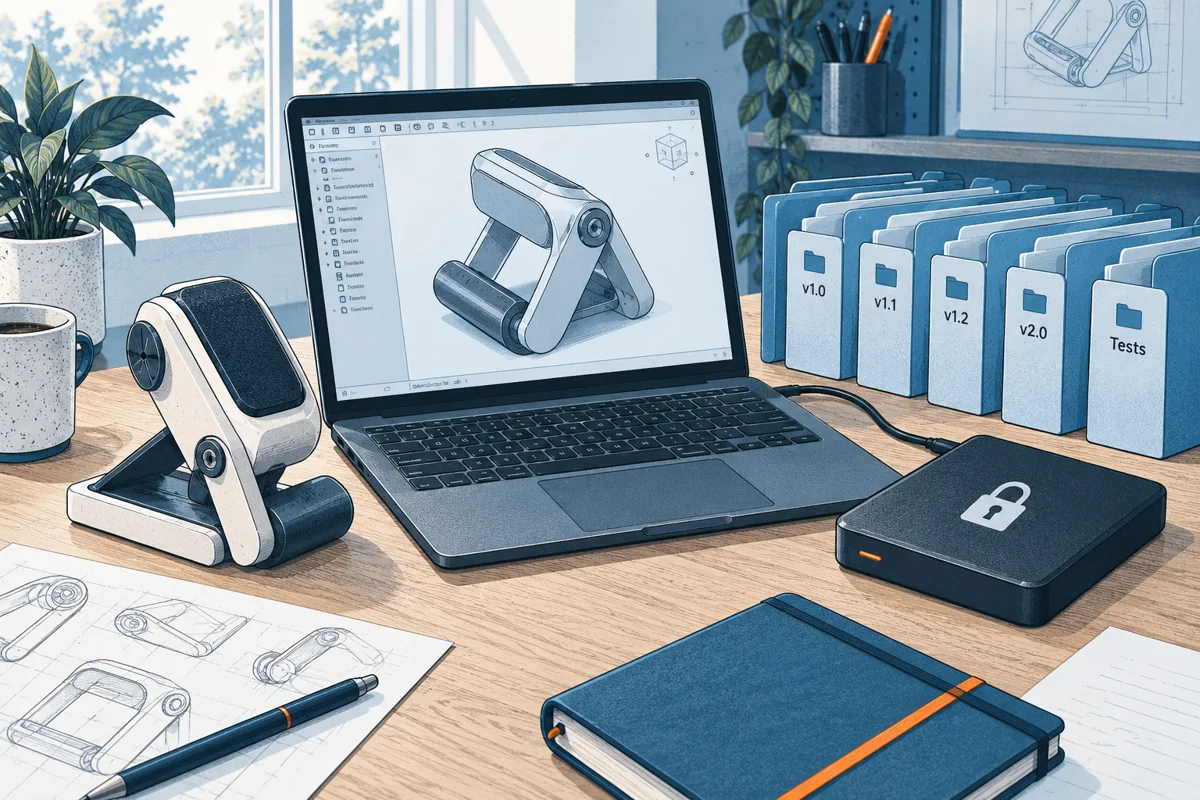
Separate working files from release packages
- Working area. Keep editable source files and internal experiments in a restricted project space.
- Review area. Prepare the specific files needed for a supplier or adviser, with clear revision identifiers.
- Public area. Store approved images, descriptions and presentations separately.
- Archive. Preserve previous releases and important decisions without leaving every obsolete link active.
- Access register. Record recipient, role, purpose, start date and review date.
A release package should be understandable on its own. Include a file list, revision and intended purpose so the recipient does not combine outdated drawings with a new model. Good document control reduces both confidentiality mistakes and expensive manufacturing errors.
A hypothetical supplier handoff
An inventor sends a machine shop the complete project folder to obtain a quote for one bracket. The folder also contains the full assembly, customer interviews and an unrelated prototype. The shop only needs the bracket drawing, material, tolerance requirements and quantity.
A better release package contains those items, a revision identifier and a named contact for questions. If the shop later needs mating geometry, the inventor adds a controlled file rather than granting permanent access to everything. This is not secrecy for its own sake; it matches information access to the actual job.
When the bracket changes, the inventor issues revision B and marks revision A obsolete in the release record. The shop confirms which version it will quote or manufacture. Technical traceability and confidentiality improve through the same disciplined handoff.
Use access that can be understood and revoked
Prefer named accounts where practical, use strong authentication, and avoid broad public links for sensitive material. Confirm whether recipients can download, reshare or invite others, and choose settings appropriate to the work. A read-only viewer may still permit screenshots or other copying, so do not describe it as impossible to extract information.
Review access when a contractor finishes, a supplier changes personnel or the project pauses. Remove permissions that are no longer needed. Keep backups protected too; a secure current folder does not help if an old unrestricted copy remains available elsewhere.
Inspect the actual file you send
CAD exports can contain hidden bodies, metadata or references you did not intend to release. Slide decks can include hidden slides and speaker notes. Spreadsheets can contain hidden sheets. Create an export copy and inspect it in the format the recipient will use, without destroying the original source.
Do not rely on renaming a file “nonconfidential.” Verify its content. If a model is simplified, ensure the simplification does not make the supplier's task impossible or misleading. Document what was omitted so later engineering decisions do not rely on an incomplete model unknowingly.
Handle an accidental share
If a sensitive file goes to the wrong recipient, promptly restrict further access where possible, preserve the facts and notify the appropriate project owner or adviser. Record what was shared, when, with whom and what controls existed. Avoid destroying evidence or claiming that revoking a link proves no one downloaded it.
Obtain legal or security advice appropriate to the information and circumstances. The response may involve confidentiality, patent timing, personal data or contractual duties. A general article cannot determine those consequences from the fact that an email was misaddressed.
A monthly control review
- Check active recipients against current project roles.
- Confirm the latest released revision for each supplier.
- Remove unnecessary public or broadly shared links.
- Verify that backups and archives have suitable access.
- Review whether new information belongs in the sensitive inventory.
- Confirm that agreements and permitted purposes still match actual work.
The finished system
You should have a sensitive-information inventory, a release-package template, an access register and an offboarding checklist. Keep the process light enough that people use it. A complex system that encourages everyone to email attachments around it can be worse than a simple, consistently followed process.
This is educational operational guidance, not legal or cybersecurity advice. The appropriate controls depend on the information, threat, business relationship and applicable requirements.