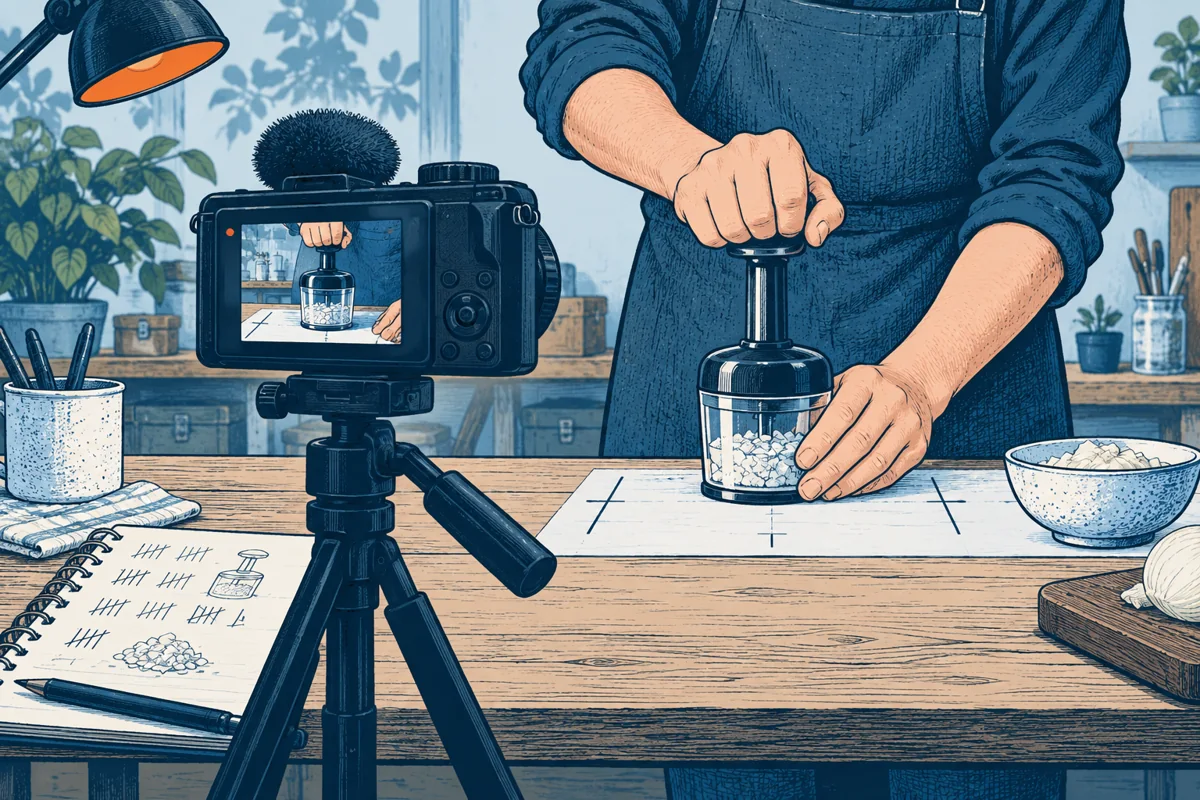
Define the question the viewer needs answered
The viewer may need to understand fit, setup, cleaning, operation, or the difference from an existing workaround. Choose one primary question for a short demonstration. A montage of attractive angles can create interest while failing to answer whether the product will work in the customer's situation.
Write the exact proposed claim and the conditions under which it is true. Identify materials, load, dimensions, user skill, and environment where relevant. If these conditions materially affect the result, make them visible or explain them clearly. Do not let a narrow test imply universal compatibility.
Design a fair comparison
Use the same task, materials, starting condition, and timing rule when comparing methods. For a hypothetical assembly aid, suppose the old method takes 120 seconds and the demonstrated method takes 90. The observed reduction is 30 seconds, or 25% of the original time. That does not establish a 25% improvement for all users or tasks.
Repeat enough to understand variability appropriate to the claim, retain failures, and document the protocol. A selected best take is not a representative average. If the video is illustrative rather than a performance test, say so and avoid presenting its timing as measured evidence.
Edit for comprehension without changing the result
Cuts can remove dead time for clarity, but they should not conceal a step needed to obtain the result. Label sped-up footage and separate setup from operation honestly. Show accessories or preparation that the customer must provide. Do not make a product appear to work unaided if an off-camera fixture is essential.
Use captions for dimensions, limitations, or status when they materially affect interpretation. Keep them readable on the intended screen. A disclaimer that viewers cannot reasonably notice may not correct an overbroad impression. Review the complete impression created by images, narration, music, and on-screen text.
Connect the video to accurate purchase information
Ensure the linked page describes the same product revision and included components. If the demonstration uses a prototype, identify that fact and avoid suggesting inventory exists when it does not. Keep objective claims supported before publishing, following the FTC's advertising guidance.
After release, collect the questions viewers still ask. Repeated confusion about fit or setup suggests missing information. Revise the demonstration to answer those questions instead of simply making it more dramatic. A useful video reduces mistaken purchases and support burden as well as helping suitable customers understand the benefit.
Preserve a test record behind the edited video
Keep the original footage, test setup, product revision, and notes supporting the published demonstration. If several attempts were made, retain enough information to understand variation and failures. This helps prevent a later editor from using a visually impressive take outside the conditions it actually supports. It also makes updates easier when the product changes.
Separate observed performance from explanatory animation. Animation can show an internal mechanism that a camera cannot capture, but it should not create a false impression of tested behavior. Label conceptual or simplified illustrations where that distinction matters. If the product's internals are still under development, do not present the animation as a verified engineering result.
Review the final edit with somebody who did not help produce it. Ask what claims they infer, not merely what words they remember. They may infer that the product works with every material shown, needs no setup, or performs instantly because transitions conceal elapsed time. Correct those impressions before publication. A technically accurate caption may not offset misleading footage. The final standard is whether the complete demonstration gives a suitable customer an accurate basis for deciding, including relevant limitations and the difference between a prototype example and a production result.
Add a publication checklist for the specific clip: product revision, demonstrated conditions, timing treatment, included accessories, claim support, and destination-page match. Have the person responsible for the product review it, not only the editor. If footage is reused in a shorter advertisement, repeat that review because removing context can broaden the implied claim. A responsible long demonstration can become misleading when reduced to a few seconds that omit setup or limitations, even though every remaining frame is authentic.
Decision checklist
- Does the footage answer a real purchase question?
- Are comparison conditions fair and documented?
- Do edits preserve the meaning of the result?
- Does the purchase page match the demonstrated version and contents?