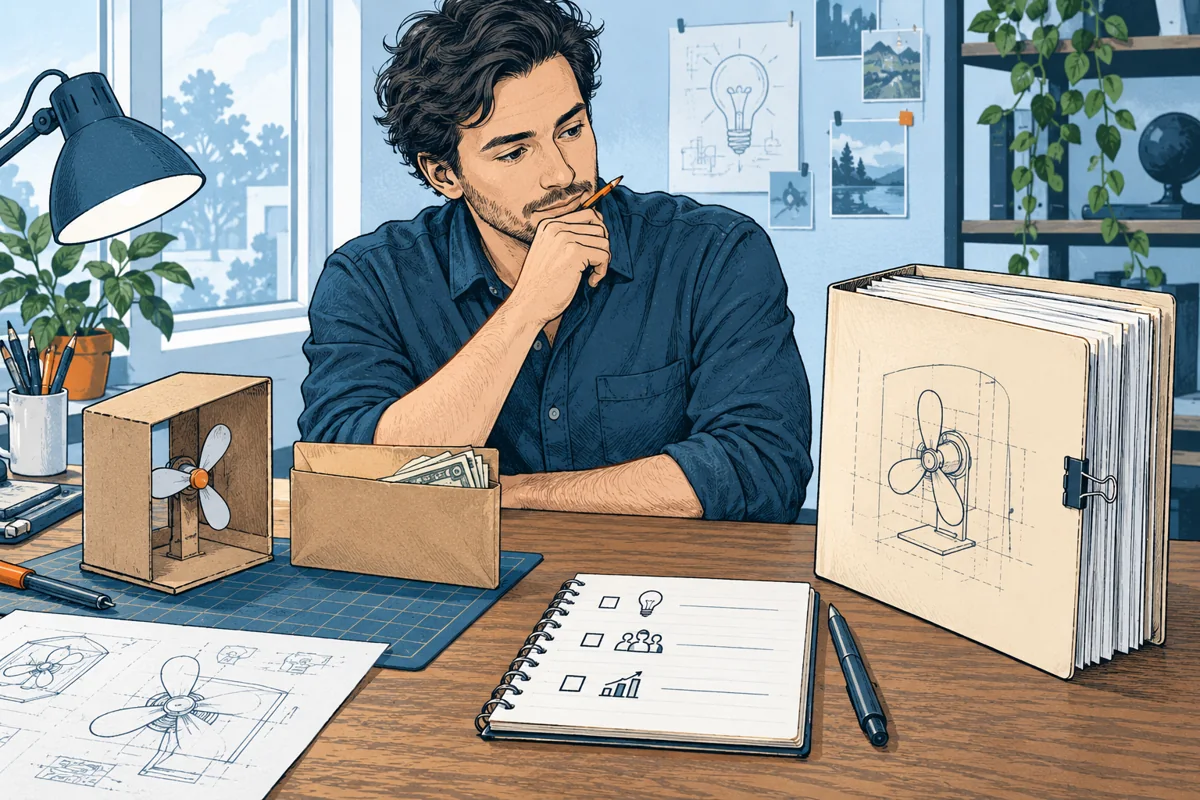
Separate discovery money from launch money
Early discovery might mean observing a workflow, constructing a basic mechanism, or checking whether an established process can produce the required feature. Launch money pays for a much larger set of commitments. Mixing the two can encourage an inventor to borrow or sell ownership before knowing which product should be built.
Write the smallest result that would justify another investment. For a hand tool, that could be a repeatable improvement in a defined task plus evidence that relevant users care about it. Ask what information could invalidate the concept cheaply. Spending to eliminate a major uncertainty can be more valuable than producing an impressive object.
Build a staged hypothetical budget
Suppose the first stage requires $300 in materials, $450 of outside fabrication, and $250 for travel and user-test logistics. The $1,000 experiment has a measurable output: a functional trial and documented observations. A later $6,000 stage remains conditional on those results, not part of an automatic spending plan.
If the first test fails, total exposure is $1,000 rather than $7,000. If it succeeds, the next funding discussion contains evidence rather than a larger version of the original story. Add actual taxes, fees, and other relevant expenses before treating these illustrative amounts as a real budget.
Compare funding sources by their consequences
Self-funding offers flexibility but concentrates loss on the inventor. A customer-funded pilot can align money with demand, yet creates delivery and contractual obligations. A development partner may contribute expertise or facilities in exchange for rights that require careful review. Equity can support risk-taking but introduces ownership and governance questions.
Do not assume that a government grant exists for any useful idea. Check a currently open program, eligible applicant, technical purpose, allowed spending, and application timing. The SBA's funding and grant resources distinguish different routes; they do not determine whether your particular project qualifies or whether an application will succeed.
Choose an explicit next decision
For each source, compare time to money, total cost, restrictions, downside, and the evidence required. A slow source may be appropriate for a later research stage but unsuitable for a near-term experiment. A fast source with obligations you cannot meet is not automatically better.
Create a one-page stage agreement with yourself and any contributors: objective, budget ceiling, ownership assumptions, decision date, and possible outcomes. After the test, choose continue, revise, pause, or abandon based on the stated evidence. Do not redefine success simply because spending has already occurred. Preserve test records even when the concept stops; they can prevent the same mistake in a later design.
Document contributions before relationships become complicated
Early projects often combine small amounts of money, unpaid work, borrowed equipment, and favors. Record what each contribution means before the prototype gains value. Is money a gift, loan, payment for future goods, or proposed investment? Is a collaborator being paid for a deliverable, contributing as an owner, or granting permission to use existing work? Those differences should not remain implicit simply because the participants know each other.
For a small technical experiment, a written scope can identify the work, cost ceiling, files to be delivered, and rights that need separate review. If somebody contributes an existing design or software component, record that fact instead of assuming all work is newly owned by the project. Appropriate professional advice is especially useful when equity, intellectual property, or repayment obligations are involved. A planning note is not a substitute for necessary agreements.
Keep a simple funding ledger with date, contributor, amount, purpose, restrictions, and supporting document. Reconcile it with spending after the experiment. This makes the next financing discussion clearer and reduces the risk of promising rights or returns that conflict with earlier commitments. It also distinguishes money actually received from helpful introductions or expressions of support. Those noncash contributions may matter, but they do not pay a fabrication invoice.
When comparing the next experiment with doing nothing, include what waiting would allow you to learn. A conversation with a relevant buyer or a written fabrication estimate may reduce uncertainty before any paid work begins. Conversely, delaying a time-sensitive test may have a real cost. Write that tradeoff explicitly. The objective is not to minimize spending at all costs, but to avoid spending that cannot change the next decision. A small budget is useful only when it produces interpretable evidence.
Decision checklist
- Is the first funded result smaller than a full launch?
- Can the downside be absorbed without relying on speculative sales?
- Are obligations and ownership effects clear for each funding source?
- Is the next stage conditional on evidence rather than enthusiasm?