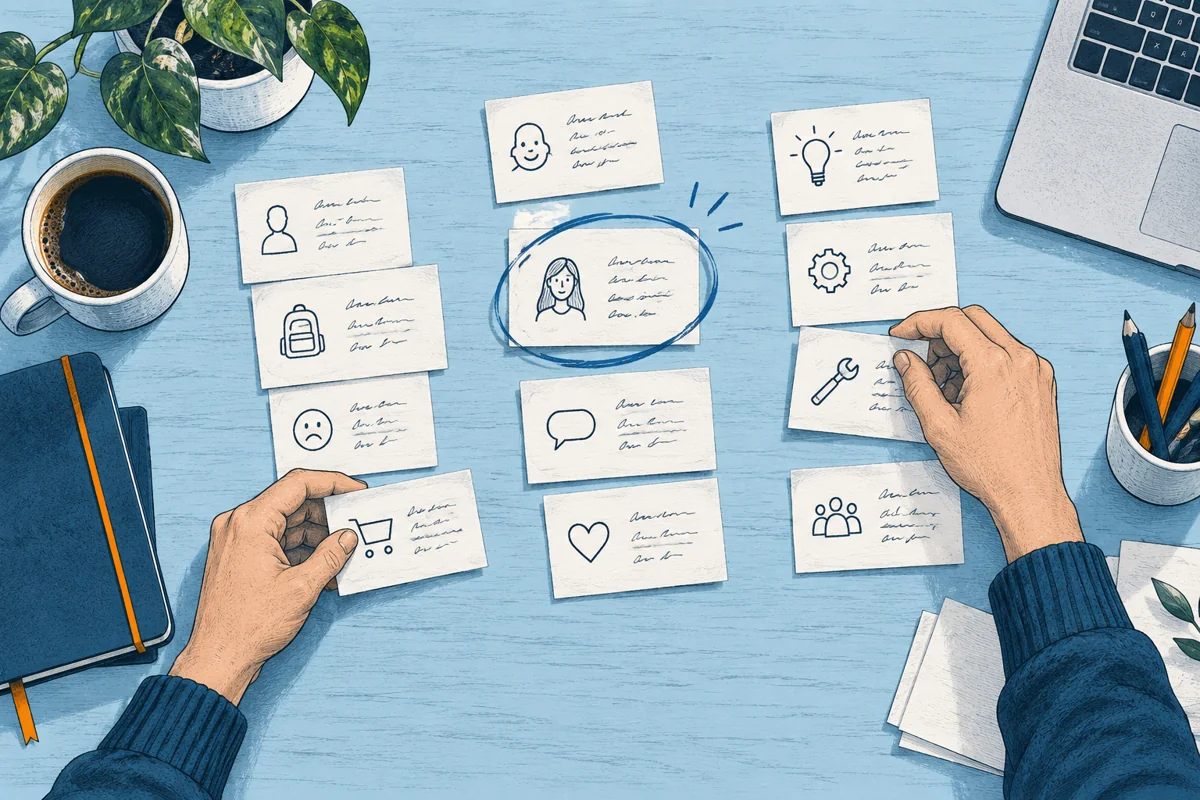
Clean the evidence before looking for themes
Interview notes often mix a participant's words, the inventor's excitement and ideas for future features. Separate those layers before analysis. Use three labels: reported fact, observed behavior and interpretation. A statement such as “I replace the clip every month” is a reported fact until independently checked. “The clip failed during the demonstration” is observed. “Durability is the main purchase driver” is an interpretation.
Assign anonymous participant IDs and retain the role, task context and recruitment channel. Those fields let you see whether a theme belongs to one segment or reflects how you recruited. Keep personal contact details in a separate file with appropriate access controls.
Create a small coding scheme
- Trigger. What starts the task or causes the problem?
- Workaround. What does the participant actually do now?
- Consequence. What time, money, effort or disruption follows?
- Constraint. What limits a possible solution, such as size, cleaning or compatibility?
- Purchase process. Who decides and under which conditions?
- Contradiction. What weakens your current hypothesis?
Start with these categories, then add topic-specific codes only when necessary. Too many codes make every interview unique and hide patterns. Too few flatten important distinctions. NSF: I-Corps customer discovery and NASA: I-Corps describe discovery as evidence for commercialization; the coding procedure here is an original method for making that evidence traceable.
A hypothetical coding example
Suppose you interview twelve people about a reusable fastening device. Four outdoor workers mention gloves, three laboratory users mention cleaning, and five household users discuss storage. The word “easy” appears in nearly every conversation, but it refers to different requirements. Coding all twelve as “want ease of use” would erase the information that should guide design.
Within the outdoor group, three describe difficulty releasing the fastener with wet gloves. The fourth uses a different attachment method successfully. Record both the pattern and the exception. The exception may identify a competing solution or an environmental difference worth testing.
Your decision could be to build a glove-handling mockup for outdoor workers, while leaving cleaning and household storage as separate hypotheses. Do not build one device with every requested feature simply because all twelve participants contributed suggestions.
Use a matrix with evidence links
| Participant | Episode | Constraint | Evidence | Interpretation |
|---|---|---|---|---|
| O-01 | Rainy equipment setup | Wet gloves | Described two failed release attempts | Release geometry merits testing |
| O-02 | Daily outdoor packing | Gloves and low visibility | Demonstrated current workaround | Tactile feedback may matter |
| O-04 | Similar setup | No reported difficulty | Uses a different fastener | Compare that alternative first |
Link each row to the relevant note or timestamp if recording was permitted. Avoid copying entire recordings into a broad shared folder. The analysis should preserve enough context to verify a conclusion without spreading unnecessary personal information.
Count carefully
One talkative participant mentioning cleaning eight times is one participant, not eight independent confirmations. Count people within the defined segment and describe the sample. “Three of four interviewed outdoor workers described wet-glove release difficulty” is transparent. “Seventy-five percent of users need this feature” implies representativeness the study does not have.
Also distinguish spontaneous concerns from prompted answers. If you asked everyone whether gloves were a problem, the responses may differ from issues raised without prompting. Both can be useful, but labeling the source helps you avoid overstating a theme's natural importance.
Challenge the strongest theme
For each major finding, ask what else could explain it. Did a particular recruitment channel attract dissatisfied users? Did a demonstration make a feature seem important? Did participants describe an unusual week? Identify a contrasting case and plan a test that could disprove your interpretation.
If a second person helps analyze notes, compare a small sample of independently coded interviews first. Disagreement can reveal ambiguous definitions or missing context. Resolve it by returning to the evidence, not by voting on which conclusion is more exciting.
Convert themes into decisions
Create three columns: finding, implication and next test. A finding might be “wet gloves prevent reliable release.” The implication is “release operation may be a key constraint for this segment.” The next test is “compare two release geometries with suitable mockups under controlled conditions.” Keep those steps separate so an inference does not silently become a fact.
Rank proposed tests by how much they could change the next spending decision. A widely mentioned cosmetic preference may be less important than one compatibility issue that makes the product unusable. Frequency is one input, not the sole prioritization rule.
The finished research memo
Include the participant definition, recruitment limitations, three or fewer major findings, contradictory evidence and the exact next decision. Attach a compact evidence matrix. State what the study cannot establish, such as market size, technical safety or purchase conversion. This makes the research useful to a designer, partner or future version of yourself without turning it into a sales story.